
Mohs Hardness Scale Explained (With Mineral Testing Guide)
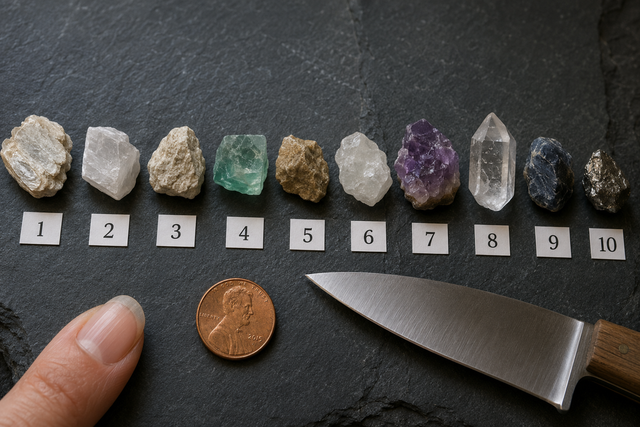
Pick up any rock from a riverbed or a hiking trail and you're already holding a question: what exactly is this? One of the oldest and most reliable ways to begin answering that question costs you nothing and requires no equipment — just your fingernail, a copper coin, and a little curiosity.
That method is the Mohs Hardness Scale, and it has been helping geologists, collectors, and curious minds identify minerals for over 200 years. This guide explains exactly how it works, what every number on the scale means, and how you can use everyday objects to test minerals yourself — no lab required.
What Is the Mohs Hardness Scale?
The Mohs Hardness Scale is a ranking system that measures a mineral's resistance to being scratched. It runs from 1 (the softest) to 10 (the hardest), with each number representing a reference mineral. A mineral with a higher number will scratch any mineral with a lower number — that is the entire principle.
It was developed in 1812 by Friedrich Mohs, a German geologist and mineralogist who needed a practical, field-ready way to distinguish minerals. Before Mohs, hardness comparisons existed — the Greek philosopher Theophrastus described similar scratch tests as far back as 300 BC — but Mohs was the first to systematise the approach by selecting ten specific reference minerals and assigning each a fixed number.
According to the National Park Service, the scale remains one of the most practical tools in field geology precisely because it requires no machinery and can be performed with objects most people already carry.
Important distinction: The Mohs scale measures scratch resistance only. It does not measure how easily a mineral breaks or fractures. Diamond is the hardest mineral on the scale — nothing scratches it — yet it can shatter if struck with a hammer at the right angle. Hardness and toughness are not the same thing.
The 10 Minerals on the Mohs Scale
Mohs chose his ten reference minerals carefully. As noted by Geology.com, with the exception of diamond, each mineral on the scale is relatively common, widely available, and inexpensive — making the scale practical for anyone, anywhere.
Hardness | Reference Mineral | Everyday Equivalent | Simple Description |
|---|---|---|---|
1 | Talc | — | Softest known mineral; feels greasy or soapy |
2 | Gypsum | Fingernail (2.5) | Can be scratched easily by a fingernail |
3 | Calcite | Copper penny (3.5) | Scratched by a coin but not a fingernail |
4 | Fluorite | — | Scratched easily by a knife blade |
5 | Apatite | Knife blade (5.5) | Scratched by a knife with some effort |
6 | Orthoclase | Steel file (6.5) | Cannot be scratched by a knife; scratches glass with difficulty |
7 | Quartz | Quartz itself | Scratches glass very easily; the most useful field reference point |
8 | Topaz | — | Scratches glass very easily; harder than quartz |
9 | Corundum | — | Includes ruby and sapphire; cuts glass cleanly |
10 | Diamond | Masonry drill (8.5+) | Hardest natural substance; nothing in nature scratches it |
One thing worth understanding early: the scale is not linear. The jump in absolute hardness from corundum (9) to diamond (10) is far greater than the jump from talc (1) to gypsum (2). As the International Gem Society explains, diamond is approximately four times harder than corundum in absolute terms, even though they sit just one number apart on the scale. The numbers are rankings, not measurements.
How to Test Mineral Hardness at Home
You do not need a professional kit to perform a meaningful hardness test. Geologists have used household objects as field references for generations. Here is a reliable set of everyday testers and their approximate Mohs values, as documented by RockHounding.org.
Fingernail — 2.5
Copper penny — 3.5
Steel nail or knife blade — 5.5
Glass plate (window glass) — 5.5
Hardened steel file — 6.5
Masonry drill bit — 8.5
By working through these testers from softest to hardest, you can narrow down any unknown mineral to a specific hardness range without owning a single piece of specialist equipment.
Step-by-Step Testing Method
The method itself is simple, but doing it correctly matters. A false mark — powdery residue left by a softer mineral on a harder surface — is often mistaken for a real scratch. Here is how to get an accurate result:
Clean the mineral surface. Wipe both the mineral and your testing tool clean. Dirt or grit on the surface can cause misleading marks.
Choose a flat area. Pick a smooth, unweathered face of the mineral to test. Weathered surfaces can give falsely low hardness readings.
Apply firm, controlled pressure. Press the point of your tester against the mineral surface and drag it across in a short stroke — no longer than 5 to 6 millimetres, as recommended by the EBSCO Research database.
Check the result carefully. Run your finger over the line. A real scratch leaves a groove you can feel. A false mark is just powder and wipes away cleanly.
Start soft, work up. Begin with your fingernail and progress to harder testers. The moment your tester fails to scratch the mineral, you have found your upper boundary.
Bracket the hardness. Identify the hardest object that cannot scratch your mineral and the softest object that can. The true hardness falls between those two values.
As an example: if a copper penny (3.5) cannot scratch your specimen but a knife blade (5.5) can, the mineral has a hardness somewhere between 3.5 and 5.5 — pointing toward fluorite (4) or apatite (5).
Hardness Ranges and What They Tell You
Once you have bracketed a hardness range, you can cross-reference it with other physical properties — colour, lustre, crystal shape, cleavage — to narrow your identification further.
Hardness 1–2: Very Soft Minerals
If a fingernail scratches it with no effort, you are holding a very soft mineral. Talc (1) has a characteristic greasy or soapy feel. Gypsum (2) is common in sedimentary environments and includes the well-known variety selenite. Soft minerals often form as secondary minerals from chemical weathering.
Hardness 2.5–3.5: Coin-Range Minerals
A copper penny scratches anything in this range. Calcite (3) is the most common mineral here and is found in limestone, marble, and chalk. A useful secondary test: calcite fizzes noticeably when a drop of dilute acid touches it, which helps distinguish it from visually similar minerals.
Hardness 4–5: Knife-Range Minerals
A steel knife blade scratches these with varying ease. Fluorite (4) is recognisable by its perfect cubic cleavage in three directions and comes in a wide range of colours — purple, green, yellow, and colourless. Apatite (5), the mineral found in your teeth and bones, sits at the upper end of this range.
Hardness 5.5–6.5: Glass-Range Minerals
Minerals here cannot be scratched by a knife blade, but a steel file still cuts them. Orthoclase feldspar (6) is one of the most common minerals in the Earth's crust and appears in granite. This hardness range is where many gemstones — moonstone, labradorite, and amazonite — are found.
Hardness 7: The Quartz Benchmark
Quartz at hardness 7 is arguably the most useful field reference point on the entire scale. Because quartz is so common in the Earth's crust, it appears in sand, riverbeds, and many rock types. Any mineral that a steel knife cannot scratch but quartz can is in the 5.5–7 range. Notably, all varieties of quartz — amethyst, rose quartz, smoky quartz, citrine — share the same hardness of 7 regardless of colour.
Hardness 8–10: Gemstone Range
Topaz (8), corundum (9 — ruby and sapphire), and diamond (10) occupy the top of the scale. These minerals scratch glass effortlessly and require specialised abrasive tools to scratch themselves. Diamond, the hardest natural substance on Earth, is used industrially in cutting, drilling, and grinding applications precisely because of this property.
Common Mistakes When Testing Hardness
Even experienced collectors make these errors. Being aware of them improves accuracy considerably.
Testing a weathered surface. The outer layer of a mineral often weathers softer than the fresh interior. Always test on a freshly broken or cleaned face where possible.
Confusing a powder mark with a scratch. When a soft mineral is rubbed against a harder one, it leaves a smear of powder that looks like a scratch. Always wipe the surface and check whether the mark remains.
Using too much force. Excessive pressure can crush soft minerals or produce misleading grooves. Use firm but controlled strokes.
Ignoring grain boundaries. Some rocks contain minerals of different hardness in close proximity. Testing across a grain boundary gives an average reading, not the hardness of either mineral individually.
Treating hardness as the only test. Hardness is one property, not the whole answer. Always combine it with colour, streak, lustre, cleavage, and crystal form. See our full guide on how to identify rocks and stones for the complete method.
Real-World Applications of the Mohs Scale
The Mohs scale is not just for field geologists and rock collectors. It has practical applications across a surprisingly wide range of industries.
Gemology: Jewellers use hardness values to assess how well a gemstone will resist daily wear. A ring stone rated below 7 will scratch noticeably from everyday contact with dust and sand, which contain quartz particles at hardness 7.
Construction: Engineers and tile manufacturers evaluate stones and ceramics using hardness data to determine suitability for floors, countertops, and wall cladding. A kitchen countertop rated below 6 will show scratching from normal use.
Electronics: Electronics manufacturers use the Mohs scale when testing the scratch resistance of touchscreen glass and flat panel display components for consumer devices.
Industrial milling: The scale helps determine which type of grinding mill and medium is best suited to reduce a given material, based on its known hardness.
Limitations of the Mohs Scale
The Mohs scale is a powerful tool, but it has real limitations worth understanding.
It is an ordinal scale, not a linear one. Equal steps on the scale do not represent equal jumps in absolute hardness. For more precise industrial applications, engineers use the Vickers or Rockwell hardness tests, which apply a controlled indentation force and produce a numerical measurement rather than a relative ranking.
The scale also measures scratch resistance only — it says nothing about fracture toughness, brittleness, or how a mineral responds to impact. Results can also vary slightly depending on the direction of scratching in certain minerals that have different physical properties along different crystal axes.
For everyday rock and mineral identification, however, none of these limitations matter much. The scale is fast, free, and remarkably effective for narrowing down what you are holding.
Frequently Asked Questions
Can two minerals with the same Mohs number scratch each other?
Yes — minerals of equal hardness can scratch each other, though the marks are often minor. This is why testing with a mineral of clearly different hardness gives cleaner results.
Why does quartz matter so much in hardness testing?
Quartz at hardness 7 is one of the most abundant minerals in the Earth's continental crust. Most sand is quartz. That means any mineral below hardness 7 will be scratched by ordinary sand over time — an important consideration for jewellery and construction materials alike.
Is a higher Mohs number always better?
For scratch resistance, yes. But a harder mineral is not necessarily tougher. Diamond (10) will scratch anything but can fracture under a sharp impact. Jade, at hardness 6–7, is considered one of the toughest minerals because of its interlocking crystal structure — it resists breaking even under significant force.
Do I need to buy a Mohs hardness kit?
Not necessarily. A fingernail, copper coin, knife blade, and piece of glass cover most of the practical testing range. A commercial kit adds reference minerals for the full scale and is useful for anyone doing regular identification work, but it is not essential for casual use.
How is the Mohs scale different from other hardness scales?
The Mohs scale is comparative and qualitative — it tells you how minerals rank relative to each other. The Vickers and Rockwell scales are quantitative, measuring the depth or area of an indentation made with a known force. For geology and mineral identification, Mohs is sufficient. For precise engineering applications, Vickers or Rockwell is preferred.
Expert Sources and Further Reading
National Park Service — Mohs Hardness Scale
Encyclopaedia Britannica — Mohs Hardness
International Gem Society — Gem Hardness Chart
EBSCO Research — Mohs Hardness Scale (Academic)
Final Thoughts
The Mohs Hardness Scale is one of those rare tools that has survived two centuries of scientific advancement largely unchanged — not because nothing better exists, but because it works so well for what it is designed to do. It is fast, intuitive, and requires nothing more than a few everyday objects and a clean surface.
Once you understand how the scale works, hardness testing becomes second nature. You start looking at every rock differently — not just as a colour or shape, but as a material with properties you can measure with your own hands.
If you are just starting out, combine hardness testing with the other identification methods in our complete beginner's guide to identifying rocks and stones . And if quartz keeps turning up in your finds — which it will — our detailed guide on how to identify quartz covers everything you need to confirm it with confidence.