
Quartz vs Calcite: How to Tell the Difference
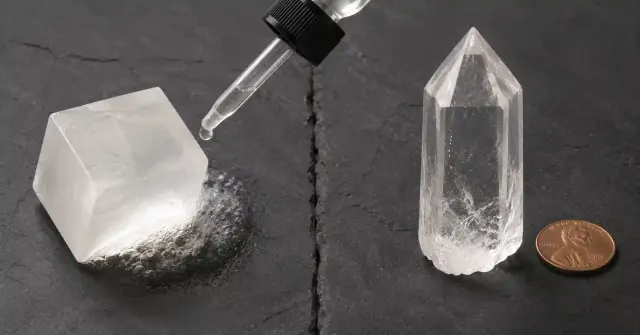
They sit next to each other in mineral displays. They turn up in the same riverbeds and the same rock formations. They can both be white, clear, or colourless, and at first glance they can look almost identical. Yet quartz and calcite are fundamentally different minerals — different chemistry, different hardness, different structure, and a completely different set of physical properties that, once you know what to look for, make them easy to tell apart.
This guide covers every reliable method for distinguishing the two, from a simple scratch test with a coin to a drop of vinegar that gives you an answer in seconds.
Why People Confuse Quartz and Calcite
The confusion is understandable. Both minerals are extremely common — quartz is the second most abundant mineral on the planet after feldspar, and calcite is a common component in sedimentary rock, metamorphic marble, and even the shells of various sea organisms. Both can form as clear or white crystals. Both appear in a range of colours depending on trace impurities. Both have a glassy or vitreous luster in their crystalline forms.
But the similarities end there. While calcite and quartz often look like geological twins, they have entirely different chemical fingerprints. Calcite is a carbonate mineral (calcium carbonate), while quartz is a silicate mineral (silicon dioxide). This core difference in their makeup dictates everything from how hard they are to how they react with common household substances.
Understanding those differences is one of the most useful foundational skills in mineral identification. If you are just starting out with rock and mineral collection, our beginner's guide to identifying minerals covers the full set of physical properties used to distinguish minerals in the field.
At a Glance: Quartz vs Calcite Comparison
Property | Quartz | Calcite |
|---|---|---|
Chemical composition | Silicon dioxide (SiO₂) | Calcium carbonate (CaCO₃) |
Mohs hardness | 7 | 3 |
Luster | Vitreous (glassy) | Vitreous to resinous to dull |
Streak | White | White |
Cleavage | None (conchoidal fracture) | Perfect in 3 directions (rhombohedral) |
Crystal form | Hexagonal prisms with pyramidal tips | Rhombohedra, scalenohedra, varied |
Acid reaction | None | Fizzes immediately |
Double refraction | No | Yes (in clear variety) |
Common colours | Clear, white, purple, pink, brown, grey | Clear, white, yellow, orange, green, pink |
Found in | Igneous, metamorphic, sedimentary rocks | Sedimentary rocks, caves, shells |
Test 1: The Hardness Test (Fastest and Most Reliable)
If you only run one test, make it this one. Hardness is the single clearest difference between these two minerals and it is something you can determine in under a minute with a coin or a knife.
Quartz is about four times harder than calcite. A piece of quartz can scratch a sample of calcite, but calcite cannot scratch quartz.
On the Mohs Hardness Scale:
Quartz = 7
Calcite = 3
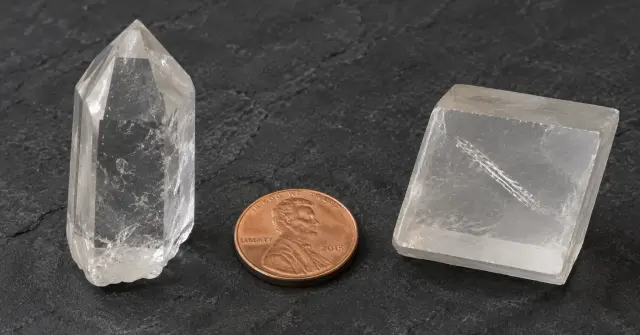
A knife blade has a hardness value between calcite and quartz. The knife can scratch a calcite crystal but will not scratch quartz. A copper coin (hardness 3.5) will scratch calcite easily but leave no mark at all on quartz.
How to do it in the field:
Find a fresh, unweathered surface on your specimen
Press a copper coin firmly against it and drag it across
If it scratches easily — calcite. If the coin slides off and leaves nothing — likely quartz
Confirm by trying a steel knife blade. If it cannot scratch the mineral either, you almost certainly have quartz
Important: Always wipe the surface and check that you have produced an actual groove, not just a smear of copper or powder. A false mark wipes away cleanly; a real scratch does not.
For a full explanation of how the Mohs scale works and what household objects to use for testing, see our complete Mohs Hardness Scale guide.
Test 2: The Acid Test (The Definitive Separator)
This is the test experienced collectors reach for first when they suspect calcite. It is fast, clear, and impossible to misread.
Vinegar can be used for the acid test as a safe, economical and easy-to-obtain acid for identifying calcite and dolomite. Vinegar is dilute acetic acid that produces a very weak reaction with calcite and dolomite — best observed with a hand lens.
While calcite (CaCO₃) bubbles strongly in cold dilute acid, silicates like quartz do not generally react with cold, dilute acids at all.
How to do it:
Place a drop of white vinegar or dilute hydrochloric acid directly onto the mineral surface
Watch closely — a hand lens helps with weak reactions
If it fizzes or bubbles, you have calcite (or another carbonate mineral)
If nothing happens, you have quartz — silicates do not react
The reaction you are seeing is carbon dioxide gas being released as the acid dissolves the calcium carbonate. Calcite will fizz without the need to powder the sample, whereas dolomite will fizz only after the rock sample is powdered — a useful distinction if you want to go further.
When you apply acid to the surface of a mineral or rock that contains calcite, you will see bubbles on the surface. If you're using a weak acid like lemon juice or vinegar, you might want to use a small hand lens to help you see the bubbles more easily.
Quartz will show absolutely no reaction. This single test, combined with the hardness test, is enough to identify either mineral with near-complete certainty.
No acid at home? Lemon juice works as a gentler substitute. The reaction will be slower and smaller, but visible bubbles on calcite confirm the result. Quartz shows nothing either way.
Test 3: Cleavage vs Fracture (How They Break)
The way a mineral breaks is a direct reflection of its internal crystal structure — and quartz and calcite break in completely different ways.
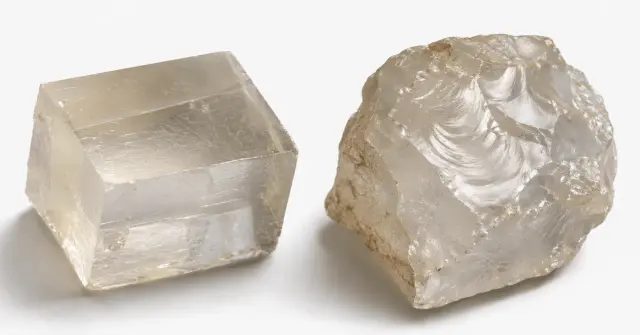
Calcite exhibits rhombic cleavage, which means that it breaks along three planes of weakness that create a rhombic shape for the crystal. Quartz does not have strong cleavage but fractures across the crystal, leaving a rough surface on the broken crystal.
What this looks like in practice:
Calcite: When a calcite crystal breaks, it produces flat, smooth faces at consistent angles. If you look at a broken piece of calcite under a hand lens, the surfaces reflect light uniformly — they look almost like tiny mirrors. The cleavage is perfect in three directions in the case of calcite. Running your finger over these surfaces, they feel flat and glass-like.
Quartz: When quartz breaks, it produces curved, shell-like surfaces called conchoidal fracture. The broken surface is irregular and catches the light at multiple angles. It looks like the inside of a broken bottle — which makes sense, since glass (an amorphous silica) behaves similarly. Running your finger over a quartz fracture, it feels rough and uneven.
This difference becomes particularly obvious when comparing fragments of each mineral:
A fragment of calcite will have consistent, flat reflective faces
A fragment of quartz will have irregular, curved, glassy surfaces with no flat planes
Test 4: Crystal Shape
When you find well-formed crystals (rather than massive or granular specimens), the crystal shape alone can confirm your identification before you run any other test.
One of the most common forms of calcite is a rhombohedron, though it also can form prismatic crystals, scalenohedra and other less common forms. The most common form of quartz is a hexagonal prism terminated with six-sided pyramids at either end of the crystal.
In plain language:
Quartz crystals look like elongated six-sided columns with pointed tips. The sides of the column are roughly equal in width, and the point at the top is formed by six triangular faces meeting at a peak. This shape is highly consistent across quartz varieties — a clear quartz crystal and a purple amethyst crystal have the same fundamental geometry. Learn more about the different varieties in our guide to identifying quartz.
Calcite crystals show much greater variety. The rhombohedron — a shape like a tilted cube with parallelogram faces — is the most recognisable. Calcite also forms scalenohedral crystals (sometimes called dog-tooth spar, because the pointed crystals resemble a dog's canine teeth), as well as flat tabular forms, and long prismatic shapes.
Most calcite minerals are trigonal and pseudo-hexagonal, which can cause confusion with quartz. The key visual difference: quartz prisms have flat sides running parallel to the length of the crystal; calcite rhombohedra have no such parallel-sided column shape.
Test 5: Luster and Appearance
Both minerals can appear glassy, but there are subtle differences that become easier to spot with experience.
While calcite has a luster that is vitreous to resinous to dull, quartz has a glassy to vitreous luster.
Calcite can look similar to quartz because it's translucent, but quartz is glassy while calcite has a softer, satiny luster.
In practice this means:
Quartz looks bright and glassy, similar to glass or crystal — clean, sharp reflections
Calcite looks slightly softer in its sheen — more of a satin finish than a sharp glassy one, particularly on cleavage faces
This distinction is subtle and not reliable on its own, but combined with other tests it adds to your overall confidence.
Test 6: Double Refraction (Clear Specimens Only)
This test only works on transparent specimens, but when it does, it is spectacular and instantly conclusive.
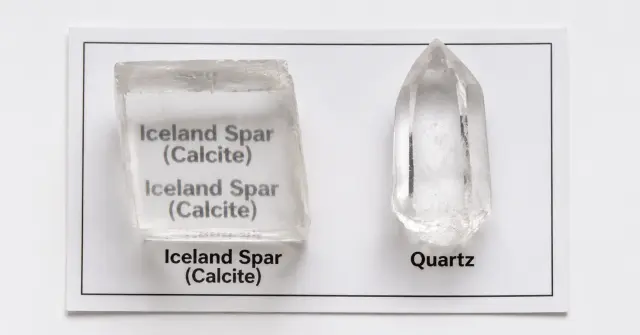
Place a clear piece of calcite (known as Iceland spar) over a line of text or a straight mark on paper. Instead of seeing one line, you will see two — a doubled image. This is called birefringence or double refraction, and calcite is one of the most dramatic examples of it in the mineral world.
Clear quartz is transparent and will not double the image beneath it. Place clear quartz over text and you see one image. Place clear calcite over text and you see two.
If you have a transparent white or clear specimen and you are unsure whether it is quartz or calcite, this test takes five seconds and produces an unmistakable result.
Test 7: Where They Are Found (Geological Context)
Knowing where a specimen came from gives you a useful head start before you run any physical tests.
Calcite is found in many sedimentary rocks, such as limestone, while quartz is more common as a component of igneous rocks, such as granite and basalt. Calcite is also the main component of stalagmites and stalactites, formations found in caves, and shells of marine organisms like sponges and oysters. Quartz is also a component of quartzite, gneiss and other metamorphic rocks, which are formed under high pressure and temperatures.
What this means for collectors:
Found a white crystal in a limestone quarry or cave? Strong prior for calcite
Picked up a clear crystal from a granite-rich riverbed or sandstone formation? Strong prior for quartz
Found something in beach sand or alluvial gravel? Almost certainly quartz — its hardness means it survives the erosive journey that destroys softer minerals
Geological context does not replace physical testing, but it reduces the number of tests you need before reaching a confident answer.
Colour: Helpful but Not Conclusive
Colour is the first thing most people look at, and the least reliable property for distinguishing these two minerals.
Calcite is colourless, white, and with light shades of orange, yellow, blue, red, pink, brown, black, green and grey. On the other hand, quartz comes in white, cloudy, purple, pink, grey, brown, and black.
As you can see, the colour ranges overlap almost completely. Both minerals appear white, colourless, pink, brown, and grey. Both get their colours from trace impurities rather than from their core chemistry.
A few colour clues that lean one way:
Deep purple large crystals → more likely amethyst (a quartz variety)
Vivid orange or honey-yellow → citrine (quartz) or orange calcite — hardness test needed
Bright green banded → more likely calcite (green calcite is common; green quartz less so)
Perfectly clear with flat faces → could be either; run the acid test
Never identify by colour alone. Use it as a starting observation, then confirm with hardness or the acid test.
Side-by-Side: Which Test to Use When
Situation | Best Test |
|---|---|
You have a coin or knife nearby | Hardness test first |
You have vinegar or lemon juice | Acid test — fastest and most definitive |
Specimen is broken or you can break it | Check cleavage vs fracture |
Specimen is a well-formed crystal | Crystal shape |
Specimen is transparent | Double refraction test |
You know where it came from | Use geological context as a guide |
For most specimens, hardness + acid test together produce a conclusive result in under two minutes with no specialist equipment.
Common Confusing Cases
"My specimen is white and looks like marble or limestone — is it quartz or calcite?" Almost certainly calcite. Limestone and marble are composed primarily of calcite. Apply a drop of vinegar — if it fizzes, confirmed. Quartz does not fizz.
"I found a clear crystal with a glassy look. How do I tell?" Try the double refraction test first if it's transparent — place it over text. Then do a hardness test. A copper coin should scratch calcite easily. If neither the coin nor a knife blade leaves any mark, you have quartz.
"My specimen looks hexagonal. Is that quartz?" Not necessarily. Calcite comes in rhombohedron, scalenohedron, hexagonal, and pinacoid forms. Most calcite minerals are trigonal and pseudo-hexagonal. True quartz hexagonal prisms have six equal-width sides running parallel along the length of the crystal; calcite pseudo-hexagonal forms are usually shorter and squatter. Do the acid test to confirm.
"Both my specimens look glassy and colourless. I can't tell them apart visually at all." This is normal. Visual identification alone fails here. Do the hardness test (coin vs knife) and the acid test. Two tests are enough.
Frequently Asked Questions
Can calcite and quartz form together in the same rock?
Yes — in fact this is common. Granite often contains both quartz and feldspar. Hydrothermal veins frequently contain quartz with calcite filling the spaces between. When both are present, testing individual crystals separately is important rather than testing the bulk rock.
Is Iceland spar just calcite?
Yes. Iceland spar is simply a name for a transparent, high-clarity variety of calcite. It is the best specimen to demonstrate double refraction because of its exceptional clarity. All Iceland spar is calcite, but not all calcite is Iceland spar.
Does all calcite fizz with vinegar?
Vinegar produces a very weak reaction with calcite and dolomite — best observed with a hand lens. Dense or coarsely crystalline calcite may fizz very faintly with vinegar. If you want a stronger reaction, scratch a small powder onto a tile and apply the vinegar to the powder — more surface area means a more visible reaction. Hydrochloric acid (available from hardware stores) produces a vigorous, unmistakable fizz.
Will quartz ever fizz with acid?
No. Quartz is a silicate mineral and silicates do not react with dilute acids under normal conditions. If your specimen fizzes, it contains carbonate minerals — and if it fizzes on the unscratched surface with just vinegar, calcite is the most likely explanation.
Is travertine quartz or calcite?
Travertine is a form of limestone — it is composed primarily of calcite, deposited by mineral springs or groundwater. It will fizz with acid and scratch easily with a knife. Despite its polished appearance in architectural settings, it is not quartz.
Expert Resources
Unearthed Store — Quartz or Calcite: Similarities and Differences
Chemistry LibreTexts — Using the Acid Test to Distinguish Carbonate Minerals
Final Thoughts
Quartz and calcite are two of the most common minerals you will ever encounter — and two of the most frequently confused. But the difference between them is not subtle once you know where to look.
A copper coin tells you within seconds whether hardness puts you in the calcite zone or the quartz zone. A drop of vinegar confirms it one way or another in seconds more. Between those two tests, you have all you need to separate these minerals in any field situation, with tools that cost almost nothing.
Start with the hardness test. Follow with the acid test. And if you have a transparent specimen, try the double refraction test for something genuinely satisfying — watching text double through a piece of Iceland spar is one of those small geological moments that never gets old.
For a deeper look at quartz identification across its many colour varieties — amethyst, rose quartz, smoky quartz, citrine, and more — our detailed guide on how to identify quartz covers all fifteen methods in full. And if you want to build a complete mineral identification toolkit, start with how to identify rocks and stones — the broader guide that puts both quartz and calcite in their full geological context.