
Rocks vs Minerals vs Stones: What's the Difference?

You hear the words constantly. "He has a rock collection." "She studies minerals." "There's a stone in my shoe." Most people use these three words interchangeably, and in casual conversation, that is perfectly fine. But in geology, each one has a specific, technical meaning — and once you understand the difference, you will never look at a handful of gravel the same way again.
This guide breaks down exactly what separates a rock from a mineral from a stone, with clear examples and simple ways to remember the distinction for good.
The Short Answer
Before the full explanation, here is the quick version:
A mineral is a naturally occurring, inorganic solid with a specific chemical composition and a crystal structure. It is a single, pure substance.
A rock is a naturally occurring solid made up of one or more minerals (or mineraloids) bound together. It is an aggregate, not a single substance.
A stone is, geologically speaking, simply another word for rock — but in everyday use, it usually refers to a smaller, often loose or worked piece, like a stone on a riverbank or a stone set into a ring.
If minerals are the ingredients, rocks are the finished dish. And stones are usually just smaller, more specific portions of that dish.
What Is a Mineral?
A mineral is the purest building block in this entire conversation. According to the U.S. Geological Survey, common minerals include quartz, feldspar, mica, amphibole, olivine, and calcite — each one a single, well-defined substance, not a mixture.
For something to officially qualify as a mineral, geologists require it to meet four conditions, as outlined by the Essential Minerals Association:
Naturally occurring — it forms through natural geological processes, not in a factory
Inorganic — it is not produced by living organisms (coal and pearl, for example, do not qualify)
Definite chemical composition — it has a specific, describable chemical formula, like SiO₂ for quartz or CaCO₃ for calcite
Crystalline structure — its atoms are arranged in a regular, repeating internal pattern
There are over 5,900 recognised minerals in the world, each with its own unique combination of hardness, colour, streak, and crystal shape. We cover exactly how to test and identify these properties in our beginner's guide to identifying minerals.
Examples of minerals: Quartz, feldspar, mica, calcite, pyrite, halite, gypsum, olivine.

What Is a Rock?
A rock is what you get when minerals — sometimes one, usually several — come together and bond into a single solid mass. The USGS describes a rock simply as an aggregate of one or more minerals, or a body of undifferentiated mineral matter.
This is the key distinction worth sitting with: a mineral is pure. A rock is a mixture.
Granite, one of the most common rocks on Earth, is a perfect example. It is not a single substance — it is composed of quartz, feldspar, and biotite mica all locked together, each one visible as separate crystals if you look closely at a polished slab. That is also why granite countertops sparkle: you are looking at distinct mineral grains catching the light differently.
Not every rock is made of multiple minerals, though. Limestone is a notable exception — it is typically made almost entirely of a single mineral, calcite, although it usually contains minor impurities. This is sometimes called a "mono-mineralic" rock.
The Three Rock Types
Rocks are classified into three categories based entirely on how they formed:
Rock Type | How It Forms | Examples |
|---|---|---|
Igneous | Cooling and solidification of molten magma or lava | Granite, basalt, obsidian |
Sedimentary | Accumulation, compaction, and cementation of sediment | Limestone, sandstone, shale |
Metamorphic | Existing rock altered by heat, pressure, or chemically active fluids | Marble, quartzite, gneiss |
This classification is one of the most fundamental concepts in geology, and it applies to every rock you will ever pick up. For a much deeper breakdown of how to recognise each type in the field, see our complete guide on how to identify rocks and stones.
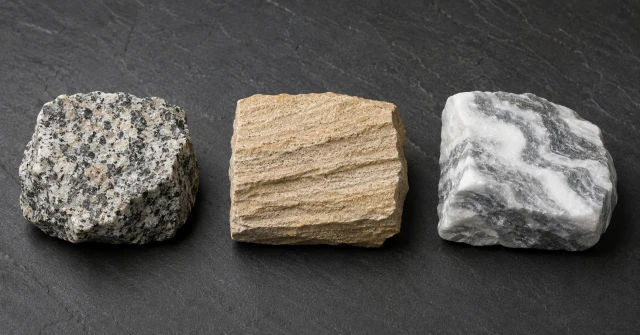
Examples of rocks: Granite, basalt, limestone, sandstone, marble, obsidian, gneiss.
What Is a Stone?
This is where things get a little less rigid — because geologically, a stone is not really a separate category at all.
As Geology In explains, the term "stone" generally refers to a smaller, detached piece of rock that has been broken off or shaped, typically by natural processes or human activity. Stones are typically smaller than rocks and are often found in streams, rivers, or oceans.
In other words: every stone is technically a rock, but the word "stone" carries a connotation of size, looseness, or use. A few patterns in how the word gets used:
Loose, eroded fragments — a river stone, a pebble on a beach, gravel
Worked or shaped material — a paving stone, a gemstone set in jewellery, a carved stone sculpture
Building material — a stone wall, a stone foundation
Common usage in place of "rock" — many people say "stone" and "rock" interchangeably in everyday speech, and Wikipedia itself notes that in geology, a rock is also sometimes simply called a stone
So while "mineral" and "rock" have firm scientific definitions, "stone" is more of a practical, everyday term layered on top of the same underlying material.
Examples of stones: River pebbles, gravel, paving stones, gemstones, cobblestones.
Rock vs Mineral vs Stone: Side-by-Side Comparison
Property | Mineral | Rock | Stone |
|---|---|---|---|
Composition | Single, pure substance | Aggregate of one or more minerals | Same as rock — usually a smaller piece |
Chemical formula | Definite and specific | Variable (depends on mineral mix) | Variable |
Crystal structure | Always present | May or may not be visible | Same as rock |
Formed by | Natural geological processes | Igneous, sedimentary, or metamorphic processes | Erosion, breakage, or shaping of rock |
Size | Microscopic to large crystals | Boulders to mountains | Typically small, handheld pieces |
Scientific category | Yes — strict definition | Yes — strict definition | No — informal/common usage term |
Example | Quartz, calcite, mica | Granite, limestone, marble | River pebble, gravel, gemstone |
Why the Confusion Happens
The overlap in everyday language is completely understandable once you see why it happens.
First, rocks are made of minerals, so the two are always connected — you cannot have a rock without minerals inside it, which makes the words feel like they describe the same thing even though they describe different scales of the same material.
Second, stone and rock genuinely do mean the same thing in formal geology much of the time. The confusion is not "wrong" — it is built into the language itself.
Third, most people never need the distinction in daily life. Saying "I found a cool rock" and "I found a cool stone" communicate exactly the same idea to almost anyone listening. The precision only starts to matter once you are trying to identify what that rock or mineral actually is — at which point, knowing whether you are looking at a single mineral or a multi-mineral rock changes your entire identification approach.
A Simple Way to Remember the Difference
Here is a mental shortcut that sticks:
Minerals are ingredients. Rocks are the recipe. Stones are the serving size.
If you are holding something and want to know which category it falls into, ask yourself:
Is it a single, pure substance with a consistent crystal structure throughout? → It is a mineral.
Is it made up of multiple minerals bonded together, or formed through melting, sediment, or pressure? → It is a rock.
Is it a smaller, loose, or shaped piece — like something from a riverbed, a garden path, or a piece of jewellery? → Colloquially, you would call it a stone, even though geologically it is still a rock.
Real-World Applications
Understanding this distinction is not just academic trivia — it shapes entire industries.
As noted by ZME Science, minerals are critical across various industries due to their unique properties. Quartz is used in glass-making, watches, and electronics because of its hardness and piezoelectric properties. Talc, soft and absorbent, is used in cosmetics and baby powder.
Rocks have entirely different applications based on their bulk properties rather than a single mineral's traits. Limestone is a key ingredient in cement manufacturing and is used to neutralise acidic soils in agriculture. Granite's durability and aesthetic appeal make it a popular choice for countertops and architectural elements, while slate's resistance to weathering makes it a preferred roofing material.
This is the practical reason geologists insist on the distinction: a mineral's value comes from its pure, predictable chemistry. A rock's value often comes from its bulk physical properties — strength, durability, appearance — which depend on how its component minerals are arranged and bonded together.
Common Examples to Lock In the Concept
Sometimes the fastest way to understand a classification system is to see it applied to familiar things.
Granite — A rock. Made of quartz, feldspar, and mica crystals visible to the naked eye.
Quartz — A mineral. A single substance, silicon dioxide, with a defined crystal structure.
Marble — A rock. A metamorphic rock formed when limestone is subjected to heat and pressure, composed mainly of recrystallised calcite.
Calcite — A mineral. The primary component of both limestone and marble, but in its pure form, a single mineral with its own distinct properties — including the fact that it fizzes when exposed to acid.
River pebble — A stone. Technically still a rock (often granite, quartzite, or basalt), but commonly called a stone or pebble because of its size and the way it was naturally shaped by water.
Diamond — A mineral. Pure carbon, crystallised under intense heat and pressure — and, notably, one of the very few minerals that originates from a process other than typical rock-forming chemistry.
Sandstone — A rock. A sedimentary rock formed primarily from cemented quartz grains, though its exact mineral content depends on the source of the original sediment.
Frequently Asked Questions
Is every rock made of more than one mineral?
No. Most rocks contain multiple minerals, but some — like limestone — are composed almost entirely of a single mineral (calcite, in limestone's case). These are sometimes called mono-mineralic rocks.
Is a gemstone a mineral or a stone?
Most gemstones are actually minerals in their pure crystalline form — diamond, ruby (corundum), emerald (beryl) are all minerals. The word "gemstone" is a common-usage term applied once that mineral has been cut, polished, or set for ornamental use. So a rough diamond crystal is a mineral; a polished diamond in a ring is commonly called a gemstone.
Can a mineral exist without forming a rock?
Yes. Minerals can occur as individual crystals — for example, a well-formed quartz crystal found loose in a cavity, or a single calcite crystal in a cave formation. These are still classified as minerals even when not part of a larger rock mass.
Why do geologists care so much about this distinction?
Because identification, classification, and even economic value depend on getting the category right. Knowing whether something is a single mineral or a multi-mineral rock changes which tests you run, what properties you should expect, and how you classify it scientifically. It also matters commercially — ores, for instance, are valued based on the concentration of a specific valuable mineral within the surrounding rock.
Is ice a mineral?
Yes, technically. Ice meets all four criteria for a mineral — naturally occurring, inorganic, a definite chemical composition (H₂O), and a crystalline structure. It is one of the more surprising examples that often catches beginners off guard.
Is coal a rock?
Coal is often classified as a sedimentary rock, but it does not fit the strict definition of being composed of minerals, since it forms from compressed organic plant material rather than inorganic mineral matter. This is one of several edge cases where geological classification gets genuinely debated.
Expert Resources
Live Science — What's the Difference Between a Rock and a Mineral?
Essential Minerals Association — Understanding the Difference Between Rocks and Minerals
ZME Science — What's the Difference Between Rocks and Minerals
Final Thoughts
The words "rock," "mineral," and "stone" get used so casually that most people never stop to ask what actually separates them — and honestly, in everyday conversation, you do not need to. But the moment you start picking up specimens with real curiosity, the distinction becomes genuinely useful.
A mineral is the pure ingredient — a single, defined substance with a crystal structure all its own. A rock is the finished product, built from one or more of those minerals bonded together through geological processes that took thousands or millions of years. And a stone, more often than not, is simply a smaller or more specific version of that same rock — shaped by a river, set into jewellery, or stacked into a wall.
Once this clicks, every walk along a beach or riverbed changes slightly. You stop seeing "rocks" as one undifferentiated category and start noticing the individual minerals catching the light inside them — which is exactly the mindset our guides on identifying minerals and identifying rocks and stones are designed to build from here.