
25 Common Rocks and Minerals You Can Easily Identify
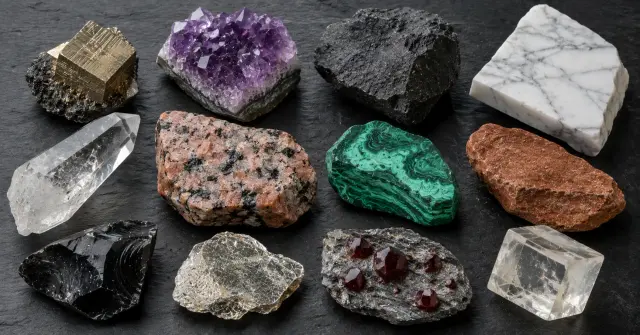
25 Common Rocks and Minerals You Can Easily Identify
Walk along any riverbed, trail, or coastline and you are surrounded by geology. The grey chunks of stone underfoot, the glittering flakes in a freshly split rock, the smooth pebble you picked up without quite knowing why — all of it is information, once you know how to read it.
The good news: you do not need to know thousands of minerals to get started. A handful of common rocks and minerals account for the vast majority of what you will ever pick up in the wild. Learn these 25, and you will be able to identify most of what you encounter — and understand why the unusual specimens stand out.
This guide is split into two parts: 15 common minerals followed by 10 common rocks, each with the key identification clues that matter most in the field.
Before you start: If you are new to mineral identification, our beginner's guide to identifying minerals covers the full set of physical properties — hardness, streak, luster, cleavage — that this guide references throughout. And if you want to understand the Mohs Hardness Scale in detail, including how to test hardness with everyday objects, that guide covers everything you need.
Part 1: 15 Common Minerals
1. Quartz
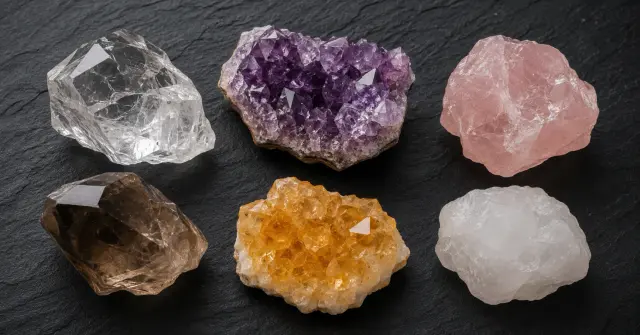
Type: Silicate mineral Hardness: 7 Colour: Clear, white, purple (amethyst), pink (rose), grey, brown (smoky), yellow (citrine) Luster: Vitreous (glassy) Key identifier: Scratches glass easily; no cleavage; conchoidal (curved, shell-like) fracture; six-sided hexagonal crystal prisms when well-formed
Quartz is the mineral you will find almost everywhere — in granite, in sand, in riverbeds, in caves. It is one of the most abundant minerals in the Earth's crust and comes in more colour varieties than almost any other common mineral. Despite the colour variation, every variety shares the same hardness (7) and the same glassy fracture. Once you recognise the way a broken quartz surface curves like the inside of a glass bottle, you will spot it instantly.
For a complete breakdown of all quartz varieties and 15 identification methods, see our dedicated guide: how to identify quartz.
2. Feldspar
Type: Silicate mineral group Hardness: 6–6.5 Colour: Pink, white, grey, cream, sometimes green (amazonite variety) Luster: Vitreous to pearly Key identifier: Two cleavage planes at roughly 90 degrees; flat reflective faces; often appears as pale, blocky crystals in granite
Feldspar is actually a group of minerals — the most common of all rock-forming minerals, making up about 60% of the Earth's crust. The two main types you will encounter are orthoclase (potassium feldspar, typically pink or cream in granite) and plagioclase (which ranges from white to grey). The flat, mirror-like cleavage faces that catch the light when you rotate a piece of granite are almost always feldspar crystals. A steel knife blade will scratch it with effort; quartz will not be scratched by the same blade.
3. Mica
Type: Silicate mineral group Hardness: 2–3 Colour: Silver-white (muscovite), black to dark brown (biotite) Luster: Pearly to silky Key identifier: Perfect cleavage in one direction produces thin, flexible, transparent sheets; flaky and glittery in appearance
Mica is one of the most recognisable minerals — those silvery or black glittery flakes you see in granite or schist are almost always mica. It peels into paper-thin sheets that bend without breaking, which is unlike any other common mineral. Muscovite is the silver variety; biotite is dark and appears as black specks. Both are soft enough to be scratched easily by a fingernail (biotite) or copper coin (muscovite).
4. Calcite
Type: Carbonate mineral Hardness: 3 Colour: White, colourless, yellow, orange, blue, green, pink — highly variable Luster: Vitreous to resinous Key identifier: Fizzes immediately with a drop of vinegar or dilute acid; perfect cleavage in three directions producing rhombohedral fragments; scratched easily by a copper coin
Calcite is everywhere — it is the primary mineral in limestone, marble, and chalk, and forms the stalagmites and stalactites in caves. The acid test is its single most diagnostic property: a drop of white vinegar on calcite produces visible bubbles as carbon dioxide is released. No other common mineral does this on an unscratched surface. For a detailed comparison with the visually similar quartz, see our guide on quartz vs calcite.

5. Pyrite
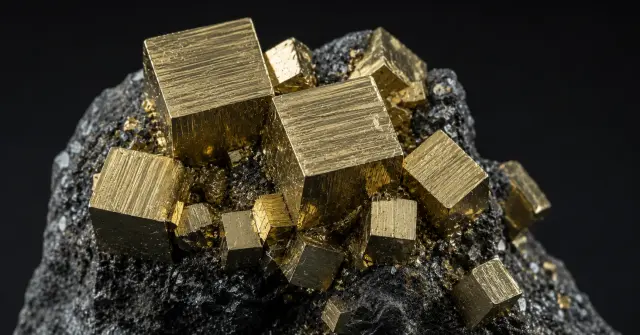
Type: Sulphide mineral Hardness: 6–6.5 Colour: Brass-yellow, metallic Luster: Metallic Key identifier: Greenish-black streak (not yellow — this is the test that distinguishes it from gold); cubic crystal form; brittle; striated (parallel lines) on crystal faces
Pyrite is better known as fool's gold — and the confusion with real gold is understandable from a distance. Up close, the differences are clear. Pyrite is brittle and shatters under a hammer; gold is malleable and dents. Pyrite leaves a greenish-black streak on a streak plate; gold leaves a gold-yellow streak. And pyrite forms distinct cubic crystals with characteristic surface lines (striations) — gold does not. At hardness 6–6.5, pyrite cannot be scratched by a knife blade easily, unlike real gold (hardness 2.5–3).
6. Magnetite
Type: Oxide mineral Hardness: 5.5–6.5 Colour: Black Luster: Metallic to submetallic Key identifier: Strongly magnetic — sticks to a fridge magnet; black streak; heavy for its size
Magnetite is the most naturally magnetic mineral on Earth and one of the easiest to identify for that reason. If your black specimen sticks to a small magnet, you have magnetite (or occasionally pyrrhotite, which is weakly magnetic). It is dense — noticeably heavier than most rocks of similar size — and leaves a black streak on a streak plate. Found in igneous and metamorphic rocks, and sometimes as black sand on beaches.
7. Hematite
Type: Oxide mineral Hardness: 5.5–6.5 Colour: Black, silver-grey, red-brown, earthy red Luster: Metallic (crystalline form), earthy (massive form) Key identifier: Always leaves a distinctive reddish-brown streak regardless of surface colour — this is its single most reliable identifier
Hematite is a good lesson in why colour alone fails as an identification test. It comes in shiny silver-black varieties that look metallic, earthy red varieties that look nothing like a mineral, and botryoidal (kidney-shaped) forms with a bumpy surface. But run any of them across a streak plate, and every single one leaves the same characteristic reddish-brown powder. That consistency is what makes hematite easy to identify despite its visual variability.
8. Halite (Rock Salt)
Type: Halide mineral Hardness: 2.5 Colour: Colourless, white, pink, orange (when impure) Luster: Vitreous Key identifier: Perfect cubic cleavage in three directions producing perfect cubes; salty taste; scratched easily by a fingernail
Halite is table salt in mineral form. Its cubic cleavage is perfect — broken fragments are tiny cubes with completely flat, reflective faces. The taste test (the one case where tasting a mineral is entirely safe) confirms it immediately. Found in evaporite sequences where ancient seas dried up, halite is also the source of many commercial salt deposits.
9. Gypsum
Type: Sulphate mineral Hardness: 2 Colour: White, grey, colourless, sometimes pink or yellow Luster: Vitreous to silky (selenite variety), pearly (satin spar variety) Key identifier: Can be scratched by a fingernail — the only common mineral where this is true; sometimes forms large transparent plate-like crystals (selenite) or fibrous masses (satin spar)
Gypsum at hardness 2 is one of the softest common minerals, and the fingernail test alone narrows it down dramatically. The transparent selenite variety forms striking flat crystal plates; satin spar forms silky white fibrous masses with a chatoyant (cat's eye) effect in light. Both varieties are gypsum. Used commercially to make plaster of Paris and drywall.
10. Olivine
Type: Silicate mineral Hardness: 6.5–7 Colour: Olive green to yellow-green Luster: Vitreous Key identifier: Distinctive olive-green colour; no cleavage; found in dark igneous rocks like basalt and peridotite
Olivine's colour is its most immediately recognisable feature — the characteristic olive-green that gives it its name. It does not cleave neatly; instead it fractures irregularly. Found predominantly in dark, iron-magnesium-rich igneous rocks, it weathers readily at the surface into brown or orange colours. The gemstone variety, peridot, is simply gem-quality olivine in a transparent green form.
11. Fluorite
Type: Halide mineral Hardness: 4 Colour: Purple, green, yellow, blue, colourless, pink — one of the most colour-variable minerals Luster: Vitreous Key identifier: Perfect cubic cleavage in four directions (octahedral cleavage); often fluorescent under UV light; hardness 4 — scratched by a knife but not a coin
Fluorite is one of the most visually striking common minerals and a favourite among collectors for its colour range and crystal clarity. Its octahedral cleavage — four directions producing eight-sided fragments — is distinctive. Many specimens glow vividly under ultraviolet light, which is in fact where the word "fluorescence" originated. At hardness 4, a steel knife scratches it, but a copper coin (3.5) barely marks it.
12. Hornblende (Amphibole)
Type: Silicate mineral (amphibole group) Hardness: 5–6 Colour: Dark green to black Luster: Vitreous to dull Key identifier: Two cleavage planes meeting at approximately 60 and 120 degrees (not 90 degrees — this distinguishes it from pyroxene); elongated, bladed or prismatic crystals; dark coloured
Hornblende is one of the most common dark minerals in igneous and metamorphic rocks. You will see it as the black, elongated crystals in granite alongside pale feldspar and glassy quartz. The cleavage angle — 60/120 degrees rather than the 90 degrees of pyroxene — is the key technical distinction, though this requires a hand lens to observe clearly.
13. Talc
Type: Silicate mineral Hardness: 1 Colour: White, pale green, grey Luster: Pearly to greasy Key identifier: Softest known mineral — scratched by everything including a fingernail; distinctive greasy or soapy feel that is unlike any other mineral; found in metamorphic rocks derived from magnesium-rich material
Talc is the reference mineral for hardness 1 on the Mohs scale, and for good reason — nothing scratches it harder. Its most memorable physical property is its feel: pick up a piece of talc and it feels unmistakably greasy or soapy, as if coated in something, even when perfectly clean and dry. This tactile quality alone identifies it immediately. Soapstone (steatite) is a rock made primarily of talc.
14. Garnet
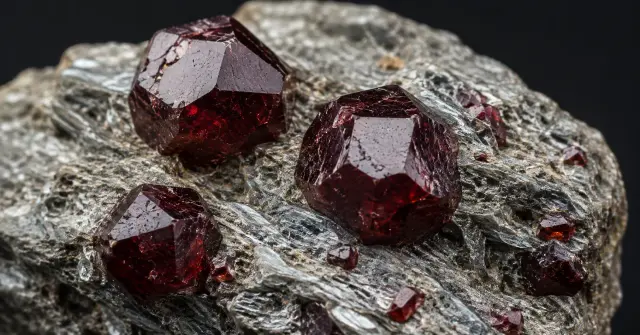
Type: Silicate mineral group Hardness: 6.5–7.5 Colour: Deep red (most common), orange, green, brown, black Luster: Vitreous to resinous Key identifier: Characteristic 12-sided (dodecahedral) crystal form; no cleavage, irregular fracture; typically found as embedded crystals in metamorphic rocks like schist and gneiss; deep red colour in common varieties
Garnet is one of those minerals that looks almost too good to be common — its deep red crystals embedded in grey schist make it a collector favourite and a frequent find in metamorphic terrain. The 12-sided crystal shape is unique among common minerals once you recognise it. Unlike many gemstones, raw garnet crystals are often still embedded in their host rock matrix rather than found loose.
15. Malachite
Type: Carbonate mineral Hardness: 3.5–4 Colour: Vivid green, often in banded or botryoidal (grape-cluster) form Luster: Vitreous to silky Key identifier: Unmistakable bright green colour with characteristic banding; fizzes with acid (it is a copper carbonate); found near copper ore deposits
Malachite's colour is one of the most vivid and distinctive in the entire mineral kingdom — a deep, saturated green that is immediately recognisable once you have seen it. The concentric banding pattern in polished specimens is equally characteristic. It forms as a weathering product of copper minerals, so finding malachite often indicates you are in an area with copper ore nearby. Like calcite, it reacts to acid — it is a carbonate mineral — but its green colour makes confusion with calcite unlikely.
Part 2: 10 Common Rocks
16. Granite
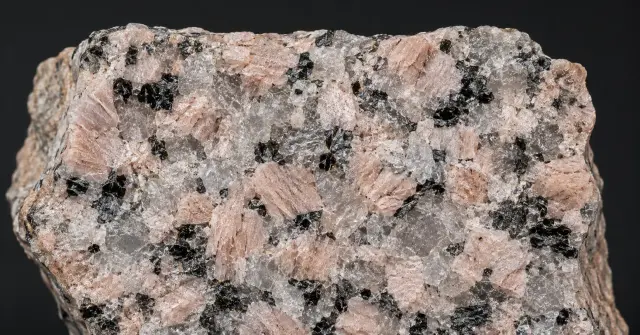
Type: Igneous (intrusive) Colour: Pink, grey, white — speckled with dark minerals Texture: Coarse-grained; individual mineral crystals visible to the naked eye Key identifier: Visible interlocking crystals of quartz (glassy grey), feldspar (pink or white), and mica or hornblende (dark flecks); no layering; salt-and-pepper appearance
Granite is arguably the most familiar rock in the world. It forms deep underground as magma cools slowly — slowly enough for large crystals to grow, which is why you can see the individual mineral grains without magnification. As noted by the Utah Geological Survey, granite is the intrusive equivalent of rhyolite but with a coarser texture due to its slower underground cooling. The quartz in granite is the glassy, irregular grey grains; the feldspar is the larger pink or white blocky crystals; the dark flecks are biotite mica or hornblende.
17. Basalt
Type: Igneous (extrusive) Colour: Dark grey to black Texture: Fine-grained; individual minerals too small to see without magnification; sometimes with visible gas holes (vesicles) Key identifier: Dark colour, fine grain, heavy; no layering; sometimes vesicular (small holes from trapped gas bubbles)
Basalt is the most abundant rock on the ocean floor and one of the most common volcanic rocks on Earth's surface. Unlike granite, it cooled rapidly from lava at or near the surface — too quickly for visible crystals to form. The result is a uniformly dark, fine-grained rock that is noticeably heavier than most light-coloured rocks of similar size. Gas holes (vesicles) sometimes appear when gases were trapped as the lava solidified.
18. Obsidian
Type: Igneous (extrusive volcanic glass) Colour: Black, occasionally brown or with gold/silver sheen (rainbow obsidian) Texture: Glassy, smooth; no visible crystals Key identifier: Conchoidal fracture producing sharp, curved edges; glassy luster; no crystals; breaks to extremely sharp edges (used historically as cutting tools)
Obsidian is volcanic glass — lava that cooled so rapidly that no crystals had time to form. The result is a completely smooth, glass-like rock that fractures in the same conchoidal (curved) pattern as quartz, but with edges sharp enough to be used as blades by ancient peoples. Its glassy luster and complete lack of any crystalline texture or layering make it one of the easier rocks to identify.
19. Limestone
Type: Sedimentary Colour: White, cream, grey, sometimes brown or yellow Texture: Fine to coarse-grained; may contain visible shell fragments or fossils Key identifier: Fizzes with dilute acid or vinegar (it is composed of calcite); often contains fossils; layered; usually light-coloured
Limestone forms from the accumulation of calcium carbonate — primarily from the remains of marine organisms — on ocean floors over millions of years. The acid test is the fastest identification method: drop a small amount of vinegar on a light-coloured sedimentary rock and visible fizzing confirms calcite content, which means limestone. Fossils are common and range from large shell impressions to microscopic marine organisms visible only with a hand lens.
20. Sandstone
Type: Sedimentary Colour: Tan, brown, red, grey, white Texture: Gritty; individual sand grains visible and feelable; rounded grains Key identifier: Visibly grainy, sandpaper-like surface texture; grains often rounded from transport by water or wind; layering common; will feel gritty and leave sand residue when rubbed
Sandstone is compacted and cemented sand — which means running your finger across it produces a characteristic gritty, sandpaper sensation that is instantly recognisable. The individual grains are usually visible to the naked eye and rounded from their transport history. The colour depends on the cementing mineral: iron oxide produces the red and orange tones common in desert sandstones; silica cement produces white or grey varieties.
21. Shale
Type: Sedimentary Colour: Grey, black, brown, red, green Texture: Very fine-grained; smooth; splits into thin flat layers Key identifier: Splits into thin flat sheets along parallel planes (fissility); very fine-grained (clay-sized particles); sometimes has a slightly earthy smell; may contain fossils
Shale is the most common sedimentary rock on Earth, formed from the compaction of clay and mud. Its defining characteristic is fissility — it splits naturally into thin, parallel layers along the planes of original deposition. The individual particles are too fine to see without a microscope. Shale often has a slightly earthy or musty smell when broken, which comes from clay minerals and organic material within it.
22. Marble
Type: Metamorphic Colour: White, grey, pink, green, black — often with coloured veins Texture: Medium to coarse-grained; interlocking calcite crystals visible with hand lens; crystalline sheen Key identifier: Fizzes with acid (it is recrystallised calcite); crystalline texture (unlike limestone, which is duller); smooth when polished; coloured veins from mineral impurities
Marble forms when limestone is subjected to heat and pressure during metamorphism — the calcite grains recrystallise into interlocking mosaic of larger crystals, which gives marble its characteristic lustre compared to the duller limestone it came from. Like limestone, it reacts to acid. The coloured veins running through marble are impurities — clay minerals, iron oxides, or other minerals — that were present in the original limestone.
23. Quartzite
Type: Metamorphic Colour: White, grey, pink, red Texture: Very hard; interlocking quartz crystals; granular surface Key identifier: Extremely hard — scratches glass easily and resists a steel knife; breaks through grains not around them (unlike sandstone, which breaks around grains); sugary crystalline texture; no layers
Quartzite forms when quartz sandstone undergoes metamorphism, causing the quartz grains to recrystallise and fuse together completely. The result is one of the hardest common rocks — it will easily scratch glass and resists most tools. The key difference from sandstone: break a piece of quartzite and the fracture cuts through the quartz grains themselves. Break sandstone and the fracture goes around the grains, leaving a rough, sandy surface.
24. Slate
Type: Metamorphic Colour: Dark grey, black, blue-grey, sometimes green or red Texture: Very fine-grained; smooth; splits into thin flat sheets Key identifier: Splits into flat, smooth sheets (slaty cleavage); makes a ringing sound when struck; harder and denser than shale; no reaction with acid; dull luster
Slate forms when shale is subjected to low-grade metamorphism — enough heat and pressure to reorient clay minerals into parallel planes, but not enough to produce visible new crystals. The result is a rock that splits into flat, smooth sheets — which is why slate has been used as a roofing material for centuries. Tap a piece of slate with a coin and it produces a clear, ringing sound; shale produces a dull thud. This simple test reliably distinguishes the two.
25. Conglomerate
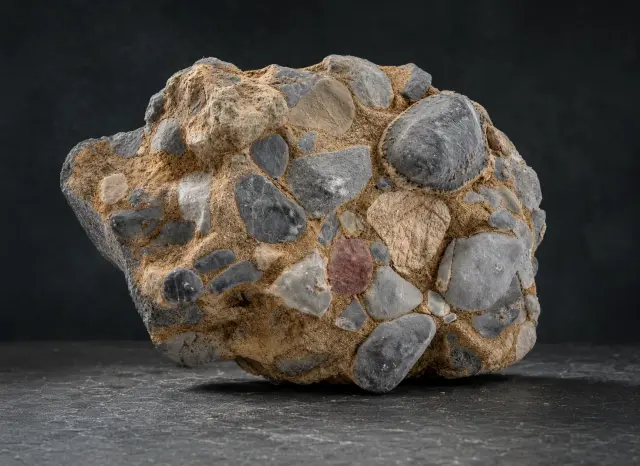
Type: Sedimentary Colour: Variable — depends on component rocks and cementing mineral Texture: Coarse; contains visible rounded pebbles or cobbles embedded in a finer matrix Key identifier: Easily visible rounded pebbles cemented together in a finer-grained matrix; individual clasts are rounded from transport by water; the "pudding stone" of geology
Conglomerate is perhaps the easiest rock to identify: it is simply rounded pebbles and cobbles cemented together by a finer matrix of sand and minerals. The rounded shape of the individual fragments shows they were transported by water before being deposited — water abrades sharp edges during transport, which is why river pebbles are smooth. Each pebble within a conglomerate is itself a miniature rock identification challenge, and they can contain virtually any rock type.
Quick Reference: All 25 at a Glance
# | Name | Type | Hardness | Most Useful Identifier |
|---|---|---|---|---|
1 | Quartz | Mineral | 7 | Glassy luster, conchoidal fracture, scratches glass |
2 | Feldspar | Mineral | 6–6.5 | Two cleavage planes at 90°, pearly flat faces |
3 | Mica | Mineral | 2–3 | Peels into thin flexible sheets |
4 | Calcite | Mineral | 3 | Fizzes with vinegar |
5 | Pyrite | Mineral | 6–6.5 | Brass-yellow, greenish-black streak, cubic crystals |
6 | Magnetite | Mineral | 5.5–6.5 | Magnetic, black streak |
7 | Hematite | Mineral | 5.5–6.5 | Always red-brown streak |
8 | Halite | Mineral | 2.5 | Cubic cleavage, salty taste |
9 | Gypsum | Mineral | 2 | Scratched by fingernail, flexible sheets |
10 | Olivine | Mineral | 6.5–7 | Olive-green colour, in dark igneous rocks |
11 | Fluorite | Mineral | 4 | Octahedral cleavage, fluorescent under UV |
12 | Hornblende | Mineral | 5–6 | Dark, 60/120° cleavage angles |
13 | Talc | Mineral | 1 | Softest mineral, greasy feel |
14 | Garnet | Mineral | 6.5–7.5 | Deep red, 12-sided crystal form |
15 | Malachite | Mineral | 3.5–4 | Vivid green banding, fizzes with acid |
16 | Granite | Rock (igneous) | — | Visible coarse crystals, speckled |
17 | Basalt | Rock (igneous) | — | Dark, fine-grained, heavy |
18 | Obsidian | Rock (igneous) | — | Glassy, conchoidal fracture, no crystals |
19 | Limestone | Rock (sedimentary) | — | Fizzes with acid, fossils common |
20 | Sandstone | Rock (sedimentary) | — | Gritty feel, visible sand grains |
21 | Shale | Rock (sedimentary) | — | Splits in thin flat sheets, earthy smell |
22 | Marble | Rock (metamorphic) | — | Fizzes with acid, crystalline sheen |
23 | Quartzite | Rock (metamorphic) | — | Extremely hard, fractures through grains |
24 | Slate | Rock (metamorphic) | — | Rings when struck, smooth flat sheets |
25 | Conglomerate | Rock (sedimentary) | — | Visible rounded pebbles in matrix |
What to Do When You Are Not Sure
Even with 25 reference points, you will encounter specimens that do not immediately fit. That is completely normal. When in doubt:
Run the hardness test first — it eliminates entire categories quickly. A copper coin and a knife blade are all you need. Full method in our Mohs Hardness Scale guide.
Do the acid test on light-coloured specimens — if it fizzes, you are in calcite/limestone/marble territory.
Check the streak — especially for dark or metallic-looking minerals. The colour of the powder is more reliable than the surface colour.
Look at how it breaks — flat cleavage faces or curved fracture? Cleavage angles?
Consider where you found it — geological context narrows the possibilities considerably.
For a step-by-step walkthrough of this full identification process, our guide on how to identify rocks and stones covers the complete method from first observation to confident identification.
Expert Resources
Utah Geological Survey — Igneous, Sedimentary and Metamorphic Rocks
Maricopa Open Digital Press — A Visual Guide to Common Minerals
The Rockhounding Hub — Igneous, Sedimentary, Metamorphic Field Guide
Rock Seeker — Common Rocks and Minerals and How to Identify Them
Final Thoughts
Twenty-five is a manageable number. Unlike the thousands of minerals that exist in theory, these 25 account for the overwhelming majority of what you will ever pick up on a walk, a hike, or a beach. Learn to recognise them reliably and you will find that most specimens reveal themselves within a minute or two of careful observation and a few simple tests.
Start with the ones you encounter most — quartz, feldspar, granite, limestone, and basalt cover an enormous percentage of everyday finds on their own. Add the streak test and a basic hardness kit, and the others follow naturally.
The more specimens you handle, the faster recognition becomes. What starts as a methodical checklist gradually becomes pattern recognition — a skill that stays with you, and makes every walk through geological terrain a little richer.