
Types of Quartz Explained (With Pictures)
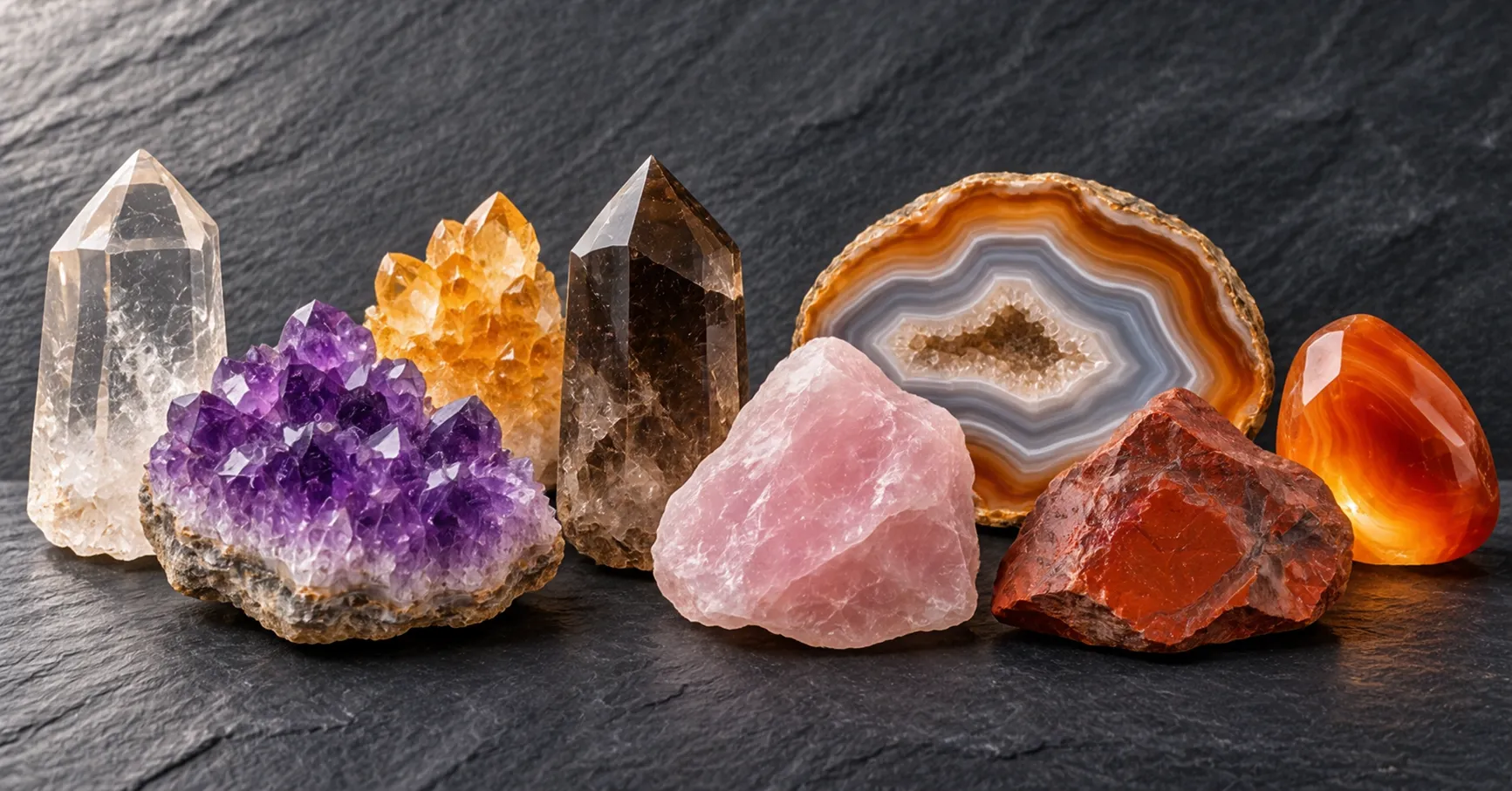
Quick answer: Quartz has two main types. Macrocrystalline quartz forms crystals you can see with the naked eye, including rock crystal, milky quartz, amethyst, citrine, smoky quartz and rose quartz. Microcrystalline quartz (chalcedony) has microscopic crystals and includes agate, jasper, carnelian and onyx. Every type is silicon dioxide (SiO₂) with a Mohs hardness of about 7, and the types differ mainly in colour, clarity and crystal size.
Key takeaways
Quartz is one mineral with many named varieties, not many different minerals.
Colour comes from trace impurities, natural radiation and heat, not from different chemistry.
According to Geology In, around 95% of citrine on the market is heat-treated amethyst or smoky quartz.
Agate has curved concentric bands, onyx has straight parallel bands, and jasper is fully opaque.
To confirm any type of quartz: hardness of about 7, white streak, glassy curved (conchoidal) fracture and no cleavage.
Walk into any crystal shop and you will see purple stones, pink stones, yellow stones, smoky brown ones and clear ones, all sold under different names and at very different prices. It is easy to assume they are different minerals.
They are not. Amethyst, citrine, rose quartz, smoky quartz, agate, jasper, carnelian and dozens of others are all quartz. This guide walks through 15 of the main types, what makes each one look the way it does, and how to tell them apart. If you still need to confirm that a specimen is quartz in the first place, start with our guide on how to identify quartz. This post answers the next question: which kind of quartz is it?
What Is Quartz?
Quartz is a naturally occurring silicate mineral made of silicon dioxide (SiO₂), and it is one of the most abundant minerals in Earth's continental crust. Pure quartz is colourless. Every coloured or patterned variety is a small departure from that pure form.
Property | Quartz |
|---|---|
Chemical formula | SiO₂ (silicon dioxide) |
Mineral class | Silicate |
Mohs hardness | 7 (about 6.5 to 7 for chalcedony) |
Streak | White |
Luster | Glassy (vitreous) in crystals; waxy to dull in massive forms |
Fracture | Conchoidal (smooth, curved) |
Cleavage | None |
Crystal system | Trigonal (grows as six-sided prisms) |
Specific gravity | About 2.6 to 2.65 |
The University of Minnesota's Common Minerals database notes that quartz appears under a bewildering array of informal names, such as jasper, flint, tiger's eye, amethyst, citrine, chalcedony, onyx and agate. Most of those names make sense once you know which of the two quartz families a stone belongs to.
What Are the Two Main Types of Quartz?
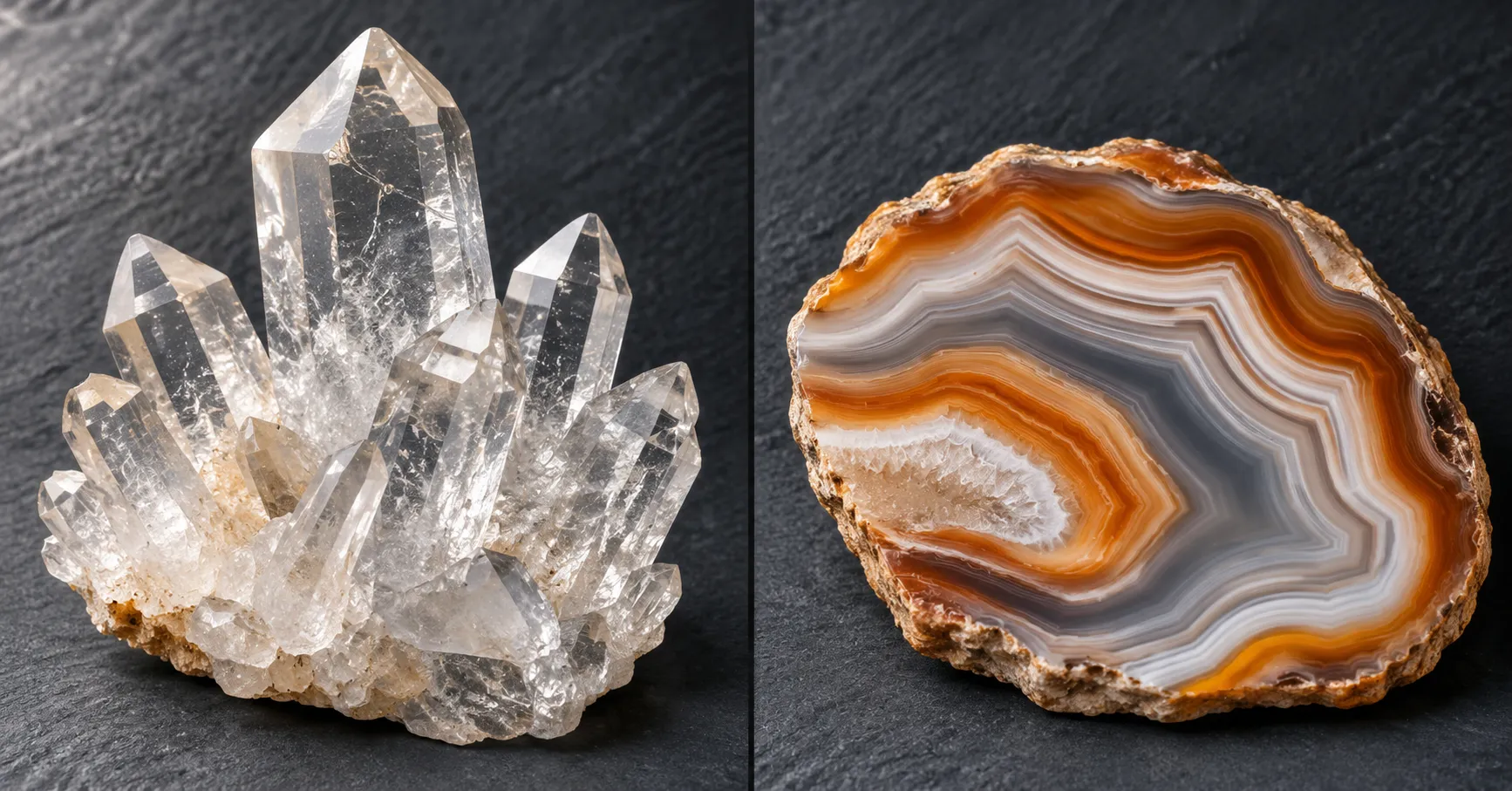
The two main types of quartz are macrocrystalline quartz, which has crystals visible to the naked eye, and microcrystalline quartz (chalcedony), which has crystals too small to see without high magnification.
Feature | Macrocrystalline | Microcrystalline (Chalcedony) |
|---|---|---|
Crystal size | Visible to the naked eye | Microscopic |
Transparency | Transparent to translucent | Translucent to opaque |
Typical shape | Six-sided prisms with pointed tips | Masses, bands, nodules, crusts |
Luster | Glassy (vitreous) | Waxy to dull |
Common examples | Amethyst, citrine, smoky quartz, rose quartz, rock crystal | Agate, jasper, carnelian, onyx, chrysoprase |
Typical hardness | 7 | About 6.5 to 7 |
As the Gem Society explains, the crystalline varieties occur as distinct, visible crystals, while the cryptocrystalline varieties are dense aggregates that look nothing like the classic quartz point.
Why Does Quartz Come in So Many Colours?
Quartz comes in many colours because of three things: trace impurities in the crystal, natural radiation, and heat. The chemistry of the quartz itself stays the same.
Trace impurities. A few atoms of iron, aluminium, titanium or manganese sitting where silicon would normally be can tint an entire crystal. The Open University notes that minute amounts of iron are enough to produce the purple of amethyst.
Natural radiation. Over thousands of years, radiation from surrounding rock damages the crystal lattice and creates colour centres that absorb light. This turns clear quartz smoky and is part of the story behind amethyst.
Heat. Heating can change or erase quartz colour. The WebExhibits Causes of Color project explains that amethyst and smoky quartz colours are lost when heated to somewhere between 300 and 500°C.
That third point matters more than most beginners realise, and it comes up again in the section on treated stones.
What Are the Types of Macrocrystalline Quartz?
Macrocrystalline quartz includes nine well-known varieties: rock crystal, milky quartz, amethyst, citrine, smoky quartz, rose quartz, ametrine, prasiolite and rutilated quartz.
Rock Crystal (Clear Quartz)
Rock crystal is the colourless, transparent variety of quartz and the purest form of the mineral.
Colour: Colourless and transparent
Cause: No significant impurities
Rock crystal is often found as well-formed six-sided crystals, and it is the baseline every other variety is measured against. It was historically cut into crystal balls and lenses, and it remains one of the most common quartz types in streams, veins and cavities.
Clear quartz can be mistaken for glass, calcite or even some topaz. Hardness and fracture settle the question quickly, and our guide on quartz vs calcite covers the most common mix-up in detail.
Milky Quartz
Milky quartz is cloudy white quartz whose colour comes from countless microscopic fluid-filled bubbles trapped inside the crystal.
Colour: Cloudy white to opaque white
Cause: Microscopic fluid inclusions that scatter light
Milky quartz is among the most abundant quartz varieties. It appears constantly as white veins running through darker rocks and as pale pebbles in riverbeds. Most people walk past it without a second look.
Amethyst
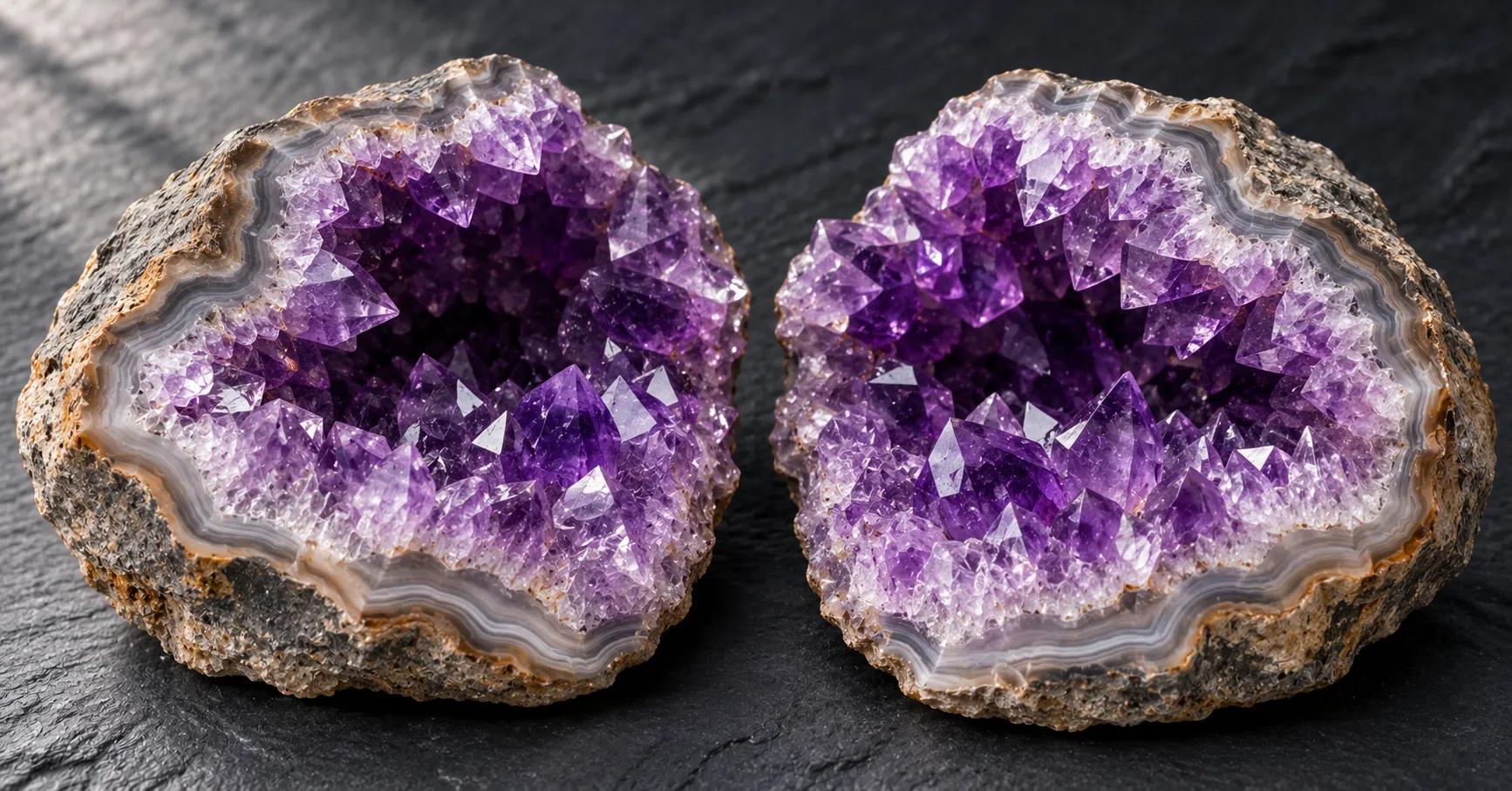
Amethyst is the purple variety of quartz, coloured by iron impurities combined with natural irradiation.
Colour: Pale lilac to deep violet
Cause: Iron plus natural irradiation
Amethyst is the best-known purple gemstone and the birthstone for February. According to Jeweller Magazine, the exact cause of its colour is still debated, but the leading explanation is iron in the crystal lattice paired with radiation from surrounding rock.
Amethyst often grows as points lining the inside of a geode, with the deepest colour concentrated near the tips. Brazil is the largest producer of amethyst, and Uruguay is known for the deepest purples.
Citrine
Citrine is the yellow to orange-brown variety of quartz, and most of the citrine sold today is made by heating amethyst or smoky quartz.
Colour: Pale yellow to golden orange to brownish orange
Cause: Iron, usually after heat treatment
Citrine is the November birthstone. According to Geology In, around 95% of the citrine on the market is created through heat treatment. Natural citrine exists but is rare, and it tends to be paler and more subtle than the saturated orange stones in most jewellery shops.
A 2020 study in Scientific Reports heated violet amethyst samples and recorded a light violet colour at 400°C, yellow at 500°C and milky white at 600°C. That narrow window is why heat-treated citrine is so common, and why the process is so tightly controlled.
Smoky Quartz
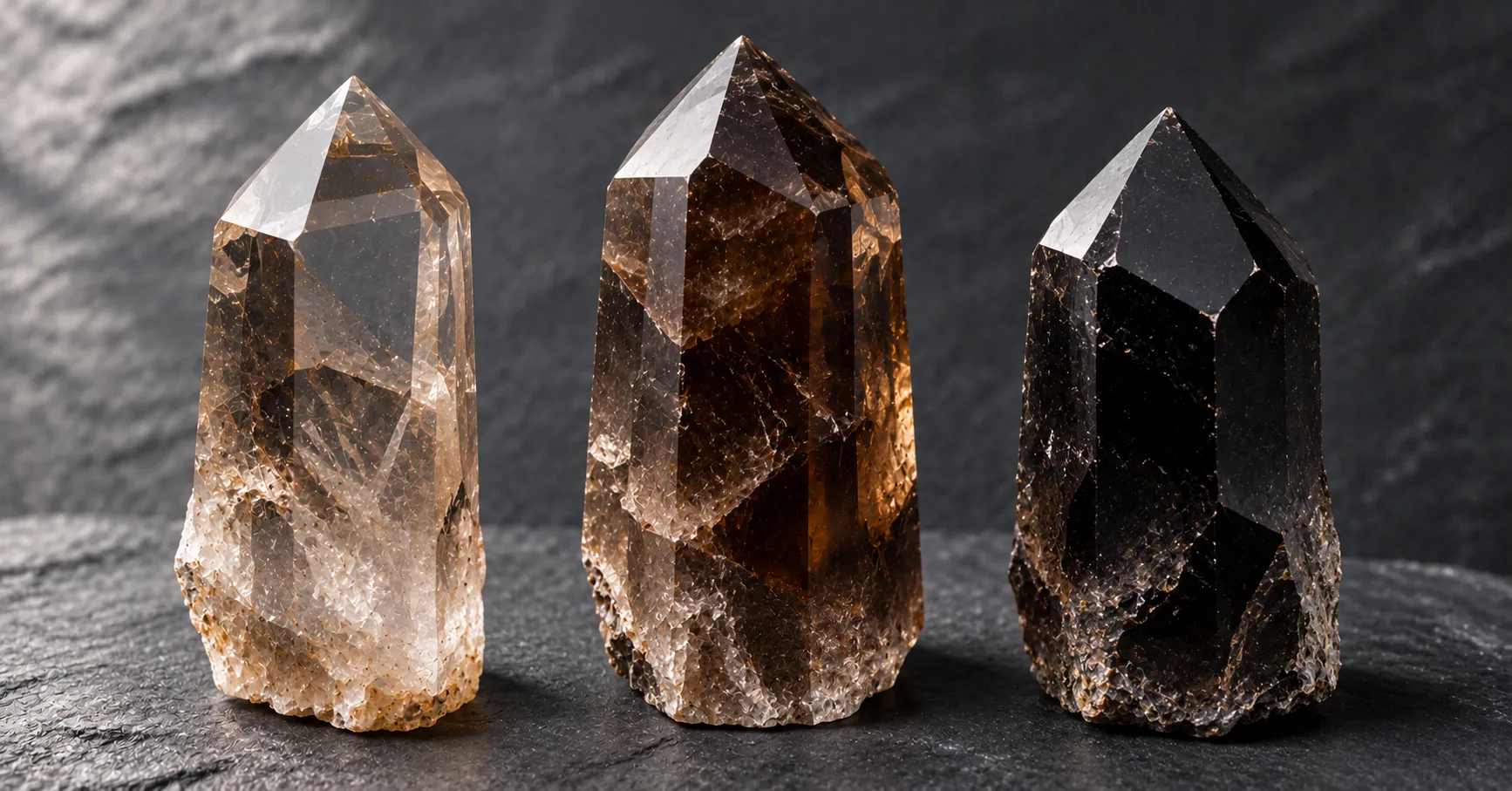
Smoky quartz is the grey to brown variety of quartz, coloured by natural radiation acting on aluminium impurities in the crystal.
Colour: Light grey-brown to dark brown, sometimes almost black
Cause: Natural radiation plus aluminium
Smoky quartz is not coloured by iron the way citrine is. According to UC Berkeley's mineral course notes, with enough aluminium and enough radiation a crystal can turn completely black. That jet-black material is called morion. Heating smoky quartz can restore its clarity, which confirms that the colour is a radiation effect rather than a stain.
Rose Quartz
Rose quartz is the pink variety of quartz, and the exact cause of its colour is not fully settled.
Colour: Pale pink to deeper rose
Cause: Titanium, manganese, or microscopic fibrous inclusions (not fully understood)
Rose quartz is the odd one out in this family. Unlike amethyst or citrine, it almost always occurs in massive form rather than as well-shaped crystals, and it is usually cloudy rather than transparent. Geology In notes that it typically forms in pegmatites and hydrothermal veins.
The Open University's mineralogy materials are candid about its colour: titanium, manganese or tiny fibrous crystals inside the quartz may all play a part. Some Madagascar material also shows a faint six-rayed star when cut, known as star rose quartz.
Ametrine
Ametrine is a natural bi-colour quartz that is part amethyst and part citrine in a single crystal.
Colour: Purple and yellow-orange in the same crystal
Cause: Different parts of one crystal formed under different conditions
The colour boundary between the two halves is often surprisingly sharp. Bolivia is the best-known source. A crystal with a clean purple-to-gold split is almost certainly ametrine.
Prasiolite
Prasiolite is the pale green variety of quartz, and nearly all of it on the market is heat-treated amethyst.
Colour: Pale leek green
Cause: Iron, after heating certain types of amethyst
Prasiolite is occasionally found naturally, but most commercial material is heated amethyst. It is often sold as "green amethyst," which is a trade name rather than a proper mineral name. The Gem Society notes that transparent green quartz is produced by heating certain amethyst.
Rutilated Quartz
Rutilated quartz is clear to smoky quartz that contains golden, red or black needle-like inclusions of the mineral rutile.
Colour: Clear to smoky, with metallic needles inside
Cause: Tiny needles of rutile trapped in the crystal
The inclusions look like fine golden hairs frozen inside glass. They can be sparse and straight or dense and tangled. Madagascar is a well-known source of high-quality material.
What Are the Types of Microcrystalline Quartz (Chalcedony)?
Chalcedony is the name for microcrystalline quartz, and its main varieties are agate, jasper, carnelian, onyx, chrysoprase and bloodstone.
Chalcedony covers a huge range of stones that most people do not think of as quartz at all. The crystals are too small to see, so the material looks smooth, waxy and solid rather than glassy and crystalline. It is usually translucent to opaque and tends to form as bands, crusts, nodules or rounded masses.
Agate
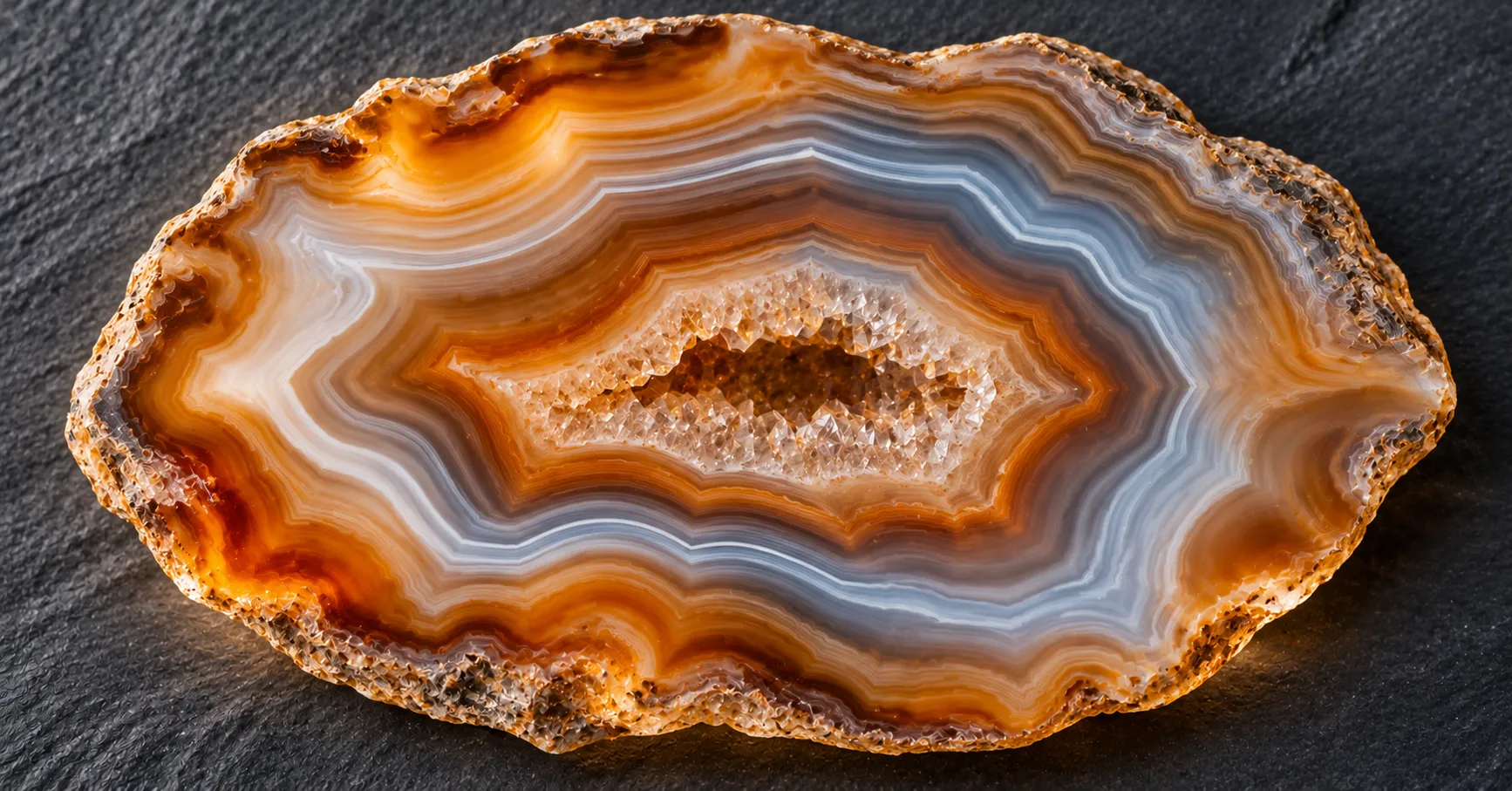
Agate is banded chalcedony, recognisable by its fine, curved, concentric layers.
Colour: Almost any, usually in concentric bands
Key feature: Layered banding
Hold a slice of agate up to the light and you often see fine stripes, rings or eye-like patterns. The bands form as silica-rich water deposits layer after layer inside cavities in volcanic rock. Agate is also frequently dyed in the gem trade, so unnaturally bright blues, pinks and purples should make you suspicious.
Jasper
Jasper is fully opaque chalcedony coloured by mineral impurities, most often iron oxide.
Colour: Red, brown, yellow, green, sometimes patterned
Key feature: Completely opaque
Iron oxide gives jasper its earthy reds and browns. It breaks with a smooth, curved surface and takes a good polish, which is why it has been used for beads, seals and carvings for thousands of years.
Carnelian
Carnelian is translucent orange to red-orange chalcedony coloured by iron.
Colour: Peach to orange to deep red-orange
Key feature: Warm glow when held to light
That glow when light passes through the stone is hard to confuse with anything else, which makes carnelian one of the easier chalcedonies to recognise.
Onyx
Onyx is chalcedony with straight, parallel bands, usually black or black and white.
Colour: Black, or black and white bands
Key feature: Flat, parallel bands
Many people expect onyx to be a separate mineral, but it is simply chalcedony with flat layers instead of curved ones. If the bands curve into rings, the stone is agate. If they run straight, it is onyx.
Chrysoprase
Chrysoprase is apple-green chalcedony coloured by traces of nickel.
Colour: Bright apple green
Key feature: Even, vivid green
Chrysoprase is one of the more valuable chalcedony varieties, and good material looks almost like green candy.
Bloodstone (Heliotrope)
Bloodstone is dark green chalcedony speckled with small red patches of iron oxide.
Colour: Dark green with red spots
Key feature: Red flecks on a green background
The pattern is distinctive enough that bloodstone is rarely mistaken for anything else.
What Other Quartz Varieties Are Worth Knowing?
Four more names come up constantly in shops and collecting circles:
Aventurine: Quartz with fine mineral inclusions, often green mica, that create a glittery shimmer.
Tiger's eye: A golden-brown banded stone with a silky shimmer that shifts as you rotate it. Sources differ slightly on how to classify it, but it is widely treated as a quartz variety.
Blue quartz: Quartz tinted by tiny inclusions, usually found in metamorphic rocks and granite.
Flint and chert: Dull, dense microcrystalline quartz that breaks with razor-sharp edges, used by early humans for tools.
Types of Quartz at a Glance
Variety | Family | Colour | What Causes It | Quick Identifier |
|---|---|---|---|---|
Rock crystal | Macro | Colourless | Pure quartz | Transparent, glassy, six-sided points |
Milky quartz | Macro | Cloudy white | Microscopic fluid inclusions | Frosted, translucent to opaque |
Amethyst | Macro | Purple | Iron plus irradiation | Colour concentrated at crystal tips |
Citrine | Macro | Yellow to orange | Iron, usually heat-treated | Often too evenly orange to be natural |
Smoky quartz | Macro | Brown to black | Natural radiation plus aluminium | Brown cast; black is morion |
Rose quartz | Macro | Pink | Titanium, manganese or inclusions | Usually cloudy and massive |
Ametrine | Macro | Purple and yellow | Zoned conditions in one crystal | Sharp colour boundary |
Prasiolite | Macro | Pale green | Heated amethyst | Pale leek green, usually treated |
Rutilated quartz | Macro | Clear with gold needles | Rutile inclusions | Golden hair-like needles |
Agate | Micro | Banded, any colour | Layered silica deposition | Curved concentric bands |
Jasper | Micro | Red, brown, yellow | Iron oxide impurities | Fully opaque, waxy |
Carnelian | Micro | Orange to red | Iron | Translucent orange glow |
Onyx | Micro | Black or banded | Layered silica | Straight parallel bands |
Chrysoprase | Micro | Apple green | Nickel | Bright, even green |
Bloodstone | Micro | Dark green with red | Iron oxide flecks | Red spots on green |
How Can You Tell Which Type of Quartz You Have?
To identify the type of quartz, first confirm the specimen is quartz, then use crystal visibility, transparency, colour and banding to name the variety.
Check whether you can see individual crystals. Visible crystals point to macrocrystalline quartz. A smooth, waxy or solid look with no crystal faces points to chalcedony.
Judge the transparency. Transparent or translucent suggests rock crystal, amethyst, citrine or smoky quartz. Opaque suggests milky quartz, jasper or another chalcedony.
Look at the colour and whether it is even. Purple, yellow, brown and pink point to the classic crystal varieties. Colour zoning inside one crystal suggests amethyst or ametrine.
Look for banding. Curved concentric bands mean agate. Straight parallel bands mean onyx. No banding but fully opaque and earthy means jasper.
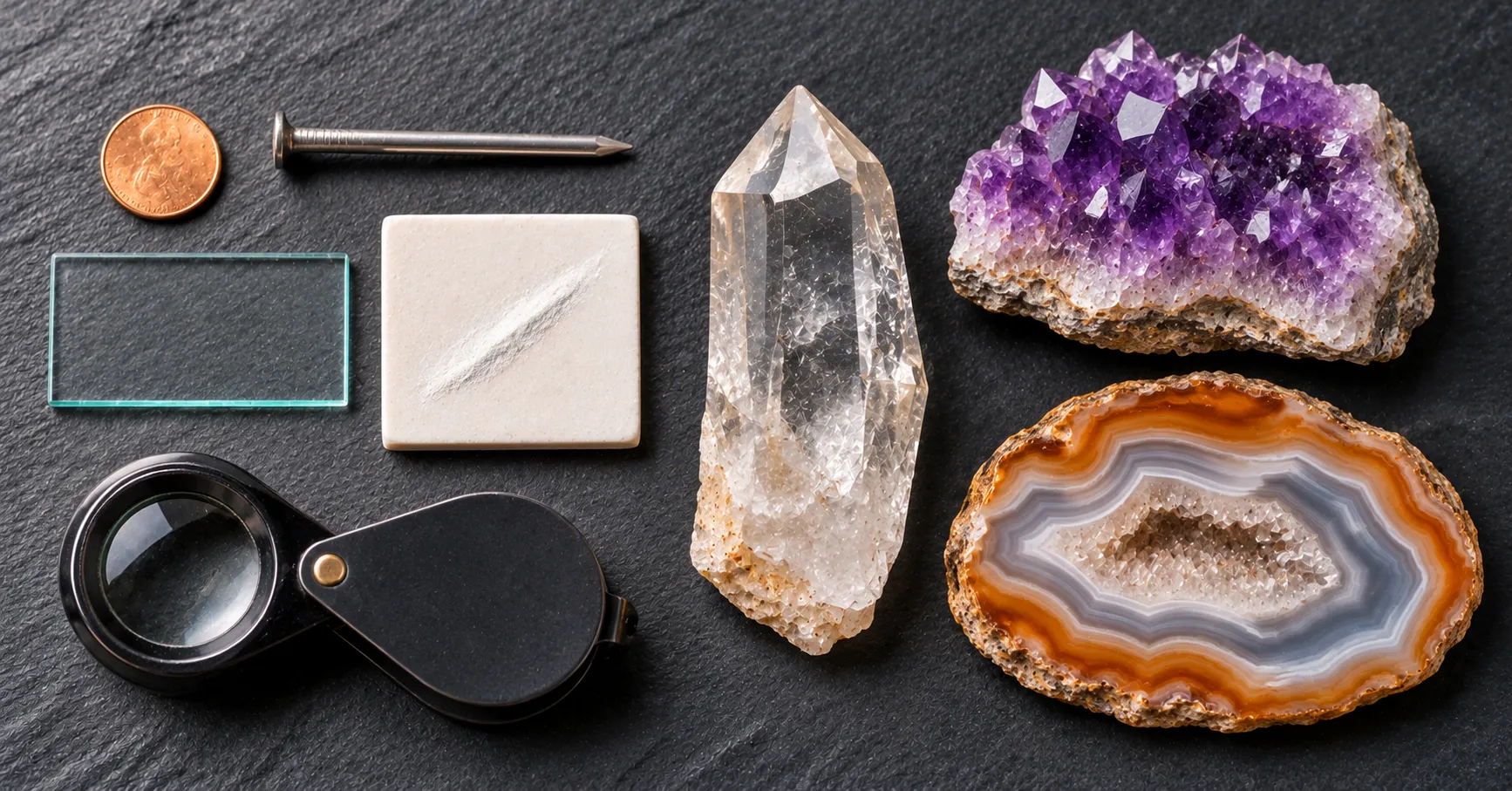
Confirm it is quartz. Every type should score about 7 on hardness, leave a white streak (or scratch the plate instead) and show glassy conchoidal fracture with no cleavage.
Our Mohs Hardness Scale guide explains the hardness test in full, and our list of 15 rock identification tests you can do at home covers streak, fracture and the rest.

Is Quartz Often Treated or Dyed?
Yes, quartz is one of the most commonly treated gemstone materials, usually through heating, irradiation or dyeing, and treated quartz is still genuine quartz.
According to the Gem Rock Auctions guide to quartz treatments, heating lightens or changes colour, irradiation can produce smoky colours, and dyeing is very common in agate. Heat treatment of macrocrystalline varieties is routine and often undisclosed at the rough and wholesale level.
A few practical signs:
Evenly orange-gold citrine is probably heated amethyst.
Green quartz sold as "green amethyst" is almost certainly heated amethyst or prasiolite.
Agate in unnaturally vivid blue, pink or purple has almost certainly been dyed.
Treatment changes colour, not structure. Heating and irradiation do not change the hardness or chemistry of the quartz.
If a stone matters financially, a gemmological laboratory report is the only way to know for sure. For a hobbyist collecting on a trail, treatment is rarely a concern.
What Are the Most Common Quartz Mix-Ups?
The most common mix-ups are quartz vs glass, quartz vs calcite, smoky quartz vs "smoky topaz," and quartz vs opal.
Quartz vs glass: Glass can look like clear quartz, but it has no crystal faces and often contains tiny round bubbles. Quartz scratches glass; glass does not scratch quartz.
Quartz vs calcite: Clear calcite is far softer and fizzes with vinegar. See our guide on quartz vs calcite for the full set of tests.
Smoky quartz vs "smoky topaz": Some shops sell smoky quartz under the name smoky topaz. It is quartz, not topaz, and it is softer.
Quartz vs opal: Opal is silica too, but it has no regular crystal structure. It is softer and not part of the quartz group.
Colour as proof: Colour tells you the variety, never the identity. Always test hardness before deciding a stone is quartz.
Frequently Asked Questions
How many types of quartz are there?
There is no official number, because many names are trade names or locality labels rather than distinct varieties. This guide covers 15 main varieties, split between macrocrystalline quartz (visible crystals) and microcrystalline quartz, or chalcedony (microscopic crystals). Amethyst, citrine, smoky quartz, rose quartz, agate and jasper are the best known.
What is the most common type of quartz?
Clear quartz (rock crystal) and milky quartz are the most common types. Milky quartz is especially abundant as white veins in rock and pale pebbles in streams. Coloured varieties such as amethyst, citrine and rose quartz are far less common, and gem-quality material is rarer still.
Are amethyst and citrine the same mineral?
Yes. Both are quartz with the same chemistry (SiO₂), crystal structure and hardness. The difference is colour, which comes from iron in the crystal and how it responds to radiation and heat. Heating amethyst can turn it yellow to orange, which is how most commercial citrine is made.
Is citrine natural?
Natural citrine exists but is rare. According to Geology In, around 95% of citrine sold today is made by heating amethyst or smoky quartz. Treated citrine is still real quartz, because only the colour has changed, not the structure or the hardness.
What is the difference between macrocrystalline and microcrystalline quartz?
Macrocrystalline quartz has crystals large enough to see without magnification and is usually transparent or translucent, like amethyst. Microcrystalline quartz, or chalcedony, is made of microscopic crystals and is translucent to opaque, like agate and jasper.
Is rose quartz a crystal or a rock?
Rose quartz is a mineral, but it usually occurs as massive, cloudy material rather than well-formed crystal points. Distinct rose quartz crystals exist but are uncommon. Its pink colour is not fully understood and may involve titanium, manganese or microscopic fibrous inclusions.
Do all types of quartz have the same hardness?
Crystalline varieties such as amethyst and citrine are all about 7 on the Mohs scale. Microcrystalline chalcedonies are slightly lower on average, around 6.5 to 7. Hardness is the most reliable test for confirming that a specimen is quartz.
Can you tell natural from treated quartz at home?
Not reliably. Dyed agate often shows unnaturally vivid colour and dye pooling in cracks, but heat-treated citrine and prasiolite are essentially undetectable without laboratory equipment. A gemmological lab report is the only way to be certain.
How can you tell quartz from glass?
Quartz scratches glass, but glass does not scratch quartz. Quartz also shows crystal faces, a glassy conchoidal fracture and no round bubbles, while glass often contains tiny bubbles and has no crystal structure.
What is the difference between onyx and agate?
Both are banded chalcedony. Agate has curved, concentric bands, often in rings or eye-like patterns, while onyx has straight, parallel bands. If the bands curve, the stone is agate. If they run flat, it is onyx.
Sources and How This Guide Was Researched
This guide draws on mineralogy references from universities, gemmological organisations and a peer-reviewed study. Facts are paraphrased and attributed in the text. Treatment percentages, such as the figure for citrine, come from the cited source and can vary by market.
Final Thoughts
Quartz is a good example of how much variety can hide inside a single mineral. A pale grey pebble, a violet geode, a golden crystal and a banded agate slice can all be the same substance wearing different clothes.
That makes quartz easier to learn, not harder. You do not need a different set of tests for each variety. Confirm hardness 7, a white streak and glassy fracture, then use colour, transparency and banding to name the variety.
To build your identification skills more broadly, our beginner's guide to identifying minerals and our list of 25 common rocks and minerals are good next stops. And if you want to see where quartz fits in the bigger geological picture, our explainer on rocks vs minerals vs stones covers that too.